Goldsmith's Natural history : with notes from all the popular treatises that have been issued since the time of Goldsmith ... / [edited] by Henry Innes, with a life of Oliver Goldsmith by George Moir Bussey.
- Oliver Goldsmith
- Date:
- [18??]
Licence: Public Domain Mark
Credit: Goldsmith's Natural history : with notes from all the popular treatises that have been issued since the time of Goldsmith ... / [edited] by Henry Innes, with a life of Oliver Goldsmith by George Moir Bussey. Source: Wellcome Collection.
835/860 page 459
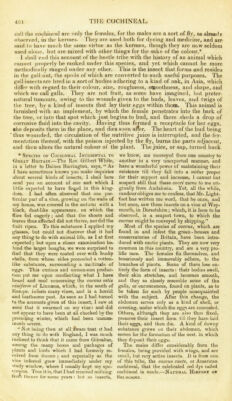
![serfs. About four-tenths of an inch above the head, or that side next the body. is a prominence, or small horn, which, if the rest of the trunk were away, would pause this part to resemble the horn of a rhinoceros. There is, indeed, a beetle so called; but then the horns or trunk has no fork at the end, though the lower horn resembles this. The feet are all forked at the end, but not like lobsters’ claws.* * VVatkr Brkti.ks.—From this numerous class we select the British hydrophilus, or water devil, of which the accompanying cuts give the natural size, and magnified. Its pupidar name bespeaks its savage propensi- ties; and in examining its peadiar structure and habits, the faculty which most strikingly attracts our attention, is its ferocious disposU tion, and the fitness of its organs for the exer- cise of its ravenous appetite. It may safely be asseited, that no known species of larva is ]>rovided with weuiions of destruction so powerful, so nnmeious, and well adapted to their end, as those which this creature pos- sesses. It measures, when at maturity, an inch and a half in length, while the superior strength and courage manifested in its at- tacks on small fish, and other animals larger than itself, is truly surprising. Indeed, its natuml history and economy, Irom the perspi- cuous pen of Mr. Pritchanl, will be read with extreme interest. .A.liout the latter end of April, and during the month of May, small nests of these in- sects are ollen found floating among the weeds and water-plants, in stagnant jHiols. They are in the form of bails, of a dusky white colour, and a silky texture, and have each a small stem of the same nature as the nest, by means of which it is attached to the roots or stalks of weeds at the bottom of the water. In this situation it remains during the winter, and is thus effectually jueserved from the effects of intense cold. Early in the sjjring, the stem or cable to which we have referred, is detached from the weeds, by the winds which at that time prevail, and the nest rises to the surface of the wafer, and there floating, imbibes the genial influence of the sun. These nests may be taken and placed in a basin of water, and, as the season advances, hatched by the heat of the sun. On the larvse leaving the nest, which they accomplish by gnawing a hole in the side, the infant larva immediately descends to the hottom of the vessel, with its jaws extended in search of prey, and eagerly devours all the small aquatic insects that are within its reach: if, however, there is a scarcity of food in the immediate neighbourhood of the nest, the larva of the same brood may be seen to devour each other. In its infant state, this larva is veiy trans- parent ; hence its internal structure may be cieariy distinguished. The circulation along lire principal arteiy on each side of the body can be distinctly observed. Tire manner in which this larva treats its prey, evinces an extraordinary degree of in- stinct. Many of the creatures on which it feeds, are crustaceous about the head and back; hence their most vulnerable part is the belly. This part, therefore, the larva attacks, and to accomplish its aim, swims undenreath the intended victim, and bending back its head, which is even with the surface of its back, is enabled to reach its prey by means of its jointed antenna;, 1, (in the cut) which represents a magnified view of the larva taken while young. Its next oiieration is to pierce it with the mandibles, 2. Having thus se- cured its object, it immediately ascends to the top of the water, and holding its prey above the surface, so as to prevent it stnig- gling, shakes it as a dug would a rat. The prey, however, of this larva, is often larger than its destroyer. Its next operation is to insert the piercer and sucker, 4, which is capable of being thrust out or withdrawn at pleasure. When the juices of the victim are not easily procured by suction or exhaustion, the serrated pair of forceps, 3, is employed to tear and masticate it, and thus cause the juices to be more easily obtained. If its food IS plentiful, this larva arrives at its full growth in the course of three or four weeks, and is then nearly opaque, and thickly covered with hair. It can be kept several days with- out food, and by this exinaiiition its structure becomes considerably mure transparent, while its natural ferocity is greatly increased, so that it will attack and tight with creatures much larger than itself, and even with its own species. On a fine sunny day the larvae arise to the surface of the water, aud delight to bask in the sun, but if watched, they remain motion- less, with their claws extended. If a stick, or any other substance, be presented to them, they will immediately seize it, and will some- times suffer themselves to be cut into pieces before they relinquish their hold. Their bite has been considered poisonous by many per- sons, as it takes a greater length of time to heal than other wounds of the same extent, so that caution should be used in taking them. Tottching the anatomy of thts creature, it may be observed, that the sucker, marked 4, is contained in a cmstaceuus sheath, and may be considerably jirotruded or completely with- drawn at the pleasure of the larva* in the cut it is shown extended. 'I'he eyes are coii>- (Htutid, but of u ]>eculiar coiiforinutija. being](https://iiif.wellcomecollection.org/image/b29010585_0835.jp2/full/800%2C/0/default.jpg)