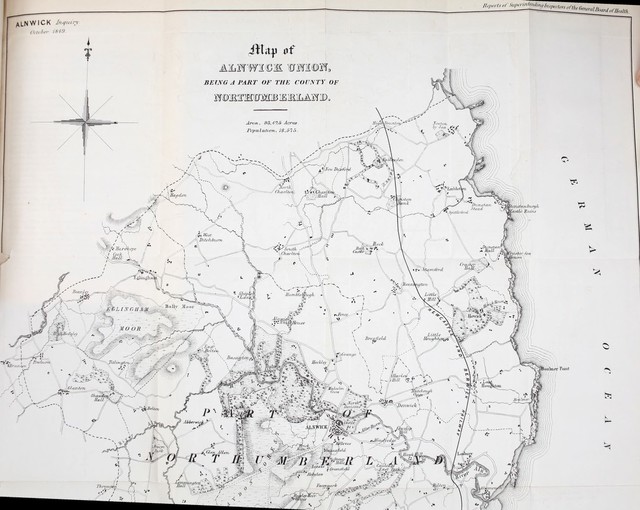
Report to the General Board of Health on a preliminary inquiry into the sewerage, drainage, and supply of water, and the sanitary condition of the inhabitants of the townships of Alnwick and Canongate, in the county of Northumberland / by Robert Rawlinson, Superintending Inspector.
- Robert Rawlinson
- Date:
- 1850
Licence: Public Domain Mark
Credit: Report to the General Board of Health on a preliminary inquiry into the sewerage, drainage, and supply of water, and the sanitary condition of the inhabitants of the townships of Alnwick and Canongate, in the county of Northumberland / by Robert Rawlinson, Superintending Inspector. Source: Wellcome Collection.
43/89 page 32
![receives the sewage of the metropolis, to every wind. In AlnwicH the drainage is to the north and east, and when the cholera broj out the wind was from this point. In Liverpool the line of dock! retain comparatively stagnant water, the basins receive most of thl drainage of the town, and the mud-banks in them are more or lesj exposed to the atmosphere every tide. The prevailing winds J Liverpool are west, or intermediate betwixt west and south, so thai any evaporation from the docks and tainted basins is dragged bacH over the town. In Wolverhampton the prevailing atmospherJ currents are also charged with any escape there may be from thl refuse of the place; but in Birmingham the prevailing wind! cany such influences away. The sanitary condition of Birmingl ham is, however, very imperfect, and fever is common, as detailed] in the able Reports of Messrs. Joseph Hodgson and James Rusi sell, surgeons. The natural fall of the site is no doubt favourable! but perfect drainage is no less required. The slope of thl ground in Wolverhampton and Liverpool is quite as favourabll as in Birmingham for perfect drainage; the only difference is thl direction of the outlet. Proper sewerage and drainage are required within every town, but the disposal of the refuse at the outfall must also be looked to if health is to be preserved. Stream j rivers, or canals cannot be turned into common sewers with im-l punity, neither can the drainage be allowed to stagnate in open! ditches, or to flow indiscriminately over large areas of wet, una drained land, but to the serious injury of health. To drain the town of Alnwick perfectly, and turn all the refuse] into the river Aln, would merely remove the source of disease! and diffuse the present evil. The refuse must not only be removed from the vicinity of human habitations, but it must also be applied to its proper use, namely, tffl manure the land, when, if all the necessary conditions are attended! to, the benefits will be of the greatest value to agriculture. In Alnwick that portion of the town which is farthest from the! riverj and comparatively the most elevated, produced the principal! number of cholera cases. The inhabitants used the same or similarl water as their more fortunate neighbours on the opposite side ofl the street; the whole of the inhabitants were exposed to the sam« action of terrestrial electricity, and the same general and common atmosphere enveloped them. Change of wind did not vary the seat of the disease after it had commenced. In Clayport-strcet it broke out, and on the south and north, where the surface-drainagej passes towards, under, and through the houses, the greatest mor-1 tality took place. No local quarantine was established, and yet thai disease did not cross a narrow street. The members of the sani-J tary committee visited the infected houses without fear, and they! and their families escaped the effects of contagion. The physical and visible causes to be found in Clayport-strecti were, large middens, foul privies, and cesspools, crowded amongst |](https://iiif.wellcomecollection.org/image/b20423469_0050.jp2/full/800%2C/0/default.jpg)