Report to the General Board of Health on a preliminary inquiry into the sewerage, drainage, and supply of water, and the sanitary condition of the inhabitants of the townships of Alnwick and Canongate, in the county of Northumberland / by Robert Rawlinson, Superintending Inspector.
- Robert Rawlinson
- Date:
- 1850
Licence: Public Domain Mark
Credit: Report to the General Board of Health on a preliminary inquiry into the sewerage, drainage, and supply of water, and the sanitary condition of the inhabitants of the townships of Alnwick and Canongate, in the county of Northumberland / by Robert Rawlinson, Superintending Inspector. Source: Wellcome Collection.
60/89 page 49
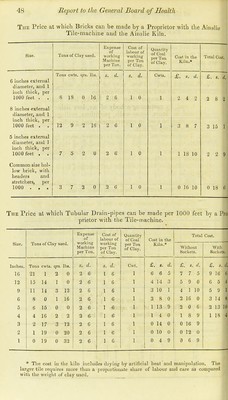
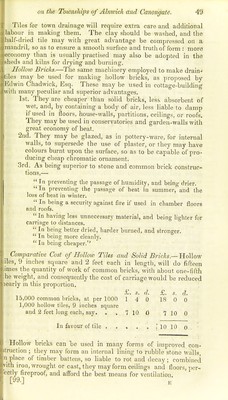
![Tiles for town drainage will require extra care and additional labour in making them. The clay should be washed, and the half-dried tile may with great advantage be compressed on a mandril, so as to ensure a smooth surface and truth of form : more economy than is usually practised may also be adopted in the iheds and kilns for drying and burning. Hollow Bricks.—The same machinery employed to make drains tiles may be used for making hollow bricks, as proposed by Edwin Chadwick, Esq. These may be used in cottage-building ith many peculiar and superior advantages. 1st. They are cheaper than solid bricks, less absorbent of wet, and, by containing a body of air, less liable to damp if used in floors, house-walls, partitions, ceilings, or roofs. They may be used in conservatories and garden-walls with great economy of heat. 2nd. They may be glazed, as in pottery-ware, for internal walls, to supersede the use of plaster, or they may have colours burnt upon the surface, so as to be capable of pro- ducing cheap chromatic ornament. 3rd. As being superior to stone and common brick construc- tions,— In preventing the passage of humidity, and being drier. In preventing the passage of heat in summer, and the loss of heat in winter. In being a security against fire if used in chamber floors and roofs. In having less unnecessary material, and being lighter for carriage to distances. In being better dried, harder burned, and stronger. In being more cleanly. In being cheaper.'1 Comparative Cost of Hollow Tiles and Solid Bricks — Hollow iles, 9 inches square and 2 feet each in length, will do fifteen imes the quantity of work of common bricks, with about, one-fifth he weight, and consequently the cost of carriage would be reduced nearly in this proportion. £. s. d. £. s. d. 15,000 common bricks, at per 1000 1 4 0 18 0 0 1,000 hollow tiles, 9 inches square and 2 feet long each, say. . . 7 10 O 7 10 0 In favour of tile . . ♦ . . « 10 10 o Hollow bricks can be used in many forms of improved con- itruction ; they may form an internal lining to rubble stone walls, n place of timber battens, so liable to rot and decay; combined yith iron, wrought or cast, they may form ceilings and floors, per- 'ectly fireproof, and afford the best means for ventilation. [99.]](https://iiif.wellcomecollection.org/image/b20423469_0067.jp2/full/800%2C/0/default.jpg)