Clinical diagnosis : a handbook for students and practitioners of medicine / Edited by James Finlayson.
- James Finlayson
- Date:
- 1878
Licence: Public Domain Mark
Credit: Clinical diagnosis : a handbook for students and practitioners of medicine / Edited by James Finlayson. Source: Wellcome Collection.
Provider: This material has been provided by the Augustus C. Long Health Sciences Library at Columbia University and Columbia University Libraries/Information Services, through the Medical Heritage Library. The original may be consulted at the the Augustus C. Long Health Sciences Library at Columbia University and Columbia University.
61/576 page 53
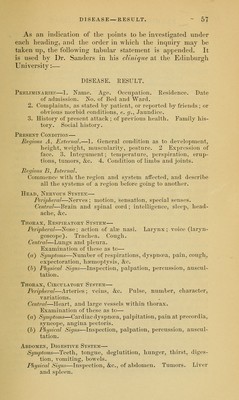
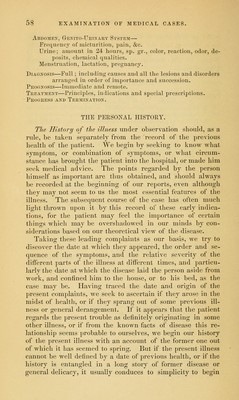
![CHAPTER II. EXAMINATION AND REPORTING OF MEDICAL CASES. CASE TAKING. In examining cases brought under his notice a physician is guided by the circumstances in which he finds the patient, and by his knowledge and experience of tlie condition with ■whicli lie has to deal, and so one case is approached in one way, and another in quite a different manner. No one method can actually be applied to all cases ; indeed no one method could possibly be the best if used indiscriminately. When a patient is gasping for breath and scarcely able to speak, we must reserve our questions for the most important points. When a patient is delirious, muddled, or obviously unreliable, it is vain to try to procure from him a connected statement of his history and his sensations. If actually in- sensible, or in a fit, we dare not delay our examination of his condition, so far as this can be ascertained, simply because we would prefer to await the arrival of information as to the previous history or the mode of attack; such delay (apart from all ])ractical questions of treatment) might deprive us of the only opportunity of ascertaining the nature of the ailment. Nor would a physician explore the family history of a person with scabies in the same way in which he would investigate this part of a phthisical case; his question directed to the patient with scabies on this matter would probably be limited to a few pointed inquiries to ascertain the infectious character of the eruption, from its presence in other members of the family. Usually we begin by inquiring more or less fully what the patient feels to be wrong ; this serves to direct the first part of our physical exploration of the organs, and the mischief detected there often sends us back to inquire into the exact way in which the illness began, the previous health, and the family history; certain points thus ascer- tained may demand a renewed examination of the organs, or the exploration of other parts. 5*](https://iiif.wellcomecollection.org/image/b21222587_0061.jp2/full/800%2C/0/default.jpg)
 No text description is available for this image
 No text description is available for this image
 No text description is available for this image