Volume 1
The Farington diary / edited by James Greig.
- Joseph Farington
- Date:
- [1922?-1928]
Licence: Public Domain Mark
Credit: The Farington diary / edited by James Greig. Source: Wellcome Collection.
114/464 (page 70)
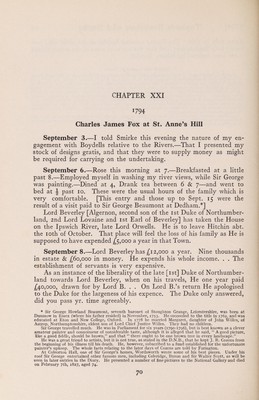
![*794 Charles James Fox at St. Anne’s Hill September 3.—I told Smirke this evening the nature of my en¬ gagement with Boydells relative to the Rivers.—That I presented my stock of designs gratis, and that they were to supply money as might be required for carrying on the undertaking. September 6.—Rose this morning at 7.—Breakfasted at a little past 8.—Employed myself in washing my river views, while Sir George was painting.—Dined at 4, Drank tea between 6 & 7—and went to bed at J past 10. These were the usual hours of the family which is very comfortable. [This entry and those up to Sept. 15 were the result of a visit paid to Sir George Beaumont at Dedham.*] Lord Beverley [Algernon, second son of the 1st Duke of Northumber¬ land, 2nd Lord Lovaine and 1st Earl of Beverley] has taken the House on the Ipswich River, late Lord Orwells. He is to leave Hitchin abt. the 10th of October. That place will feel the loss of his family as He is supposed to have expended £5,000 a year in that Town. September8.—Lord Beverley has £12,000 a year. Nine thousands in estate & £60,000 in money. He expends his whole income. . . The establishment of servants is very expensive. As an instance of the liberality of the late [1st] Duke of Northumber¬ land towards Lord Beverley, when on his travels, He one year paid £40,000, drawn for by Lord B. . . On Lord B.’s return He apologised to the Duke for the largeness of his expence. The Duke only answered, did you pass yr. time agreeably. * Sir George Howland Beaumont, seventh baronet of Stoughton Grange, Leicestershire, was bom at Dunmow in Essex (where his father resided) in November, 1753. He succeeded to the title in 1762, and was educated at Eton and New College, Oxford. In 1778 he married Margaret, daughter of John Willes, of Astrop, Northamptonshire, eldest son of Lord Chief Justice Willes. They had no children. Sir George travelled much. He was in Parliament for six years (1790-1796), but is best known as a clever amateur painter and connoisseur of considerable taste, although it is alleged that he said, “ A good picture, like a good fiddle, should be brown,” and that “ there ought to be one brown tree in every landscape.” He was a great friend to artists, but it is not true, as stated in the D.N.B., that he kept J. R. Cozens from the beginning of his illness till his death. He, however, subscribed to a fund established for the unfortunate painter’s upkeep. The whole facts relating to the later days of Cozens are told by Farington. At Coleorton Hall, one of Sir George’s homes, Wordsworth wrote some of his best pieces. Under his roof Sir George entertained other famous men, including Coleridge, Byron and Sir Walter Scott, as will be seen in later entries in the Diary. He presented a number of fine pictures to the National Gallery and died on February 7th, 1827, aged 74.](https://iiif.wellcomecollection.org/image/b3135970x_0001_0116.jp2/full/800%2C/0/default.jpg)