The food value of sea mussels / by Irving A. Field.
- Field, Irving Angell, 1870-1921.
- Date:
- 1911
Licence: In copyright
Credit: The food value of sea mussels / by Irving A. Field. Source: Wellcome Collection.
Provider: This material has been provided by The University of Leeds Library. The original may be consulted at The University of Leeds Library.
20/74 page 94
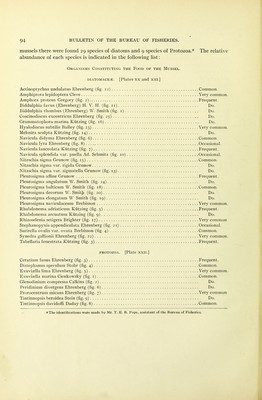
![mussels there were found 29 species of diatoms and 9 species of Protozoa.0 The relative abundance of each species is indicated in the following list: Organisms Constituting the: Food of the Mussel. diatom ace.®. [Plates xx and xxi.] Actinoptychus undulatus Ehrenberg (fig. 12) Common. Amphiprora lepidoptera Cleve Very common. Amphora proteus Gregory (fig. 2) Frequent. Biddulphia favus (Ehrenberg) H. V. H. (fig. 11) Do. Biddulphia rhombus (Ehrenberg) W. Smith (fig. 1) Do. Coscinodiscus excentricus Ehrenberg (fig. 25) Do. Grammatophora marina Kiitzing (fig. 16) Do. Hyalodiseus subtilis Bailey (fig. 23) Very common. Melosira sculpta Kiitzing (fig. 14) Do. Navicula didyma Ehrenberg (fig. 6) Common. Navicula lyra Ehrenberg (fig. 8). . . Occasional. Navicula lanceolata Kiitzing (fig. 7) Frequent. Navicula splendida var. puella Ad. Schmitz (fig. 10) Occasional. Nitzschia sigma Grunow (fig. 15) Common. Nitzschia sigma var. rigida Grunow Do. Nitzschia sigma var. sigmatella Grunow (fig. 13) Do. Pleurosigma affine Grunow Frequent. Pleurosigma angulatum W. Smith (fig. 24) Do. Pleurosigma balticum W. Smith (fig. 18) Common. Pleurosigma decorum \V. Smith (fig. 20) Do. Pleurosigma elongatum W Smith (fig. 19) Do. Pleurosigma naviculaceum Brebisson Very common. Rhabdonema adriaticum Kiitzing (fig. 5) Frequent. Rhabdonema arcuatum Kiitzing (fig. 9) Do. Rhizoselenia setigera Brighter (fig. 17) Very common Stephanopyxis appendiculata Ehrenberg (fig. 21) Occasional. Surirella ovalis var. ovata Brebisson (fig. 4) Common. Synedra gallionii Ehrenberg (fig. 22) Very common. Tabellaria fenestrata Kiitzing (fig. 3) Frequent. protozoa. [Plate xxn.] Ceratium fusus Ehrenberg (fig. 3) Frequent. Distephanus speculum Stohr (fig. 4) Common. Exuvisella lima Ehrenberg (fig. 5) Very common. Exuviaella marina Cienkowsky (fig. 1) Common. Glenodinium compressa Calkins (fig. 2) Do. Peridinium divergens Ehrenberg (fig. 6) Do. Prorocentrum micans Ehrenberg (fig. 7) Very common Tintinnopsis beroidea Stein (fig. 9) Do. Tintinnopsis davidoffi Daday (fig. 8) Common. “The identifications were made by Mr. T. E. B. Pope, assistant of the Bureau of Fisheries.](https://iiif.wellcomecollection.org/image/b21537616_0020.jp2/full/800%2C/0/default.jpg)