The food value of sea mussels / by Irving A. Field.
- Field, Irving Angell, 1870-1921.
- Date:
- 1911
Licence: In copyright
Credit: The food value of sea mussels / by Irving A. Field. Source: Wellcome Collection.
Provider: This material has been provided by The University of Leeds Library. The original may be consulted at The University of Leeds Library.
34/74 page 108
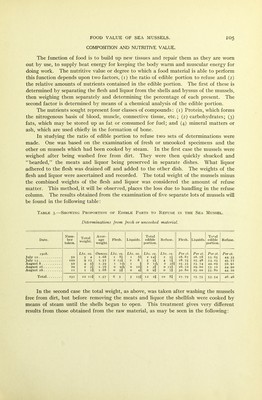
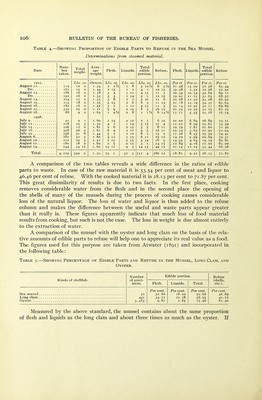
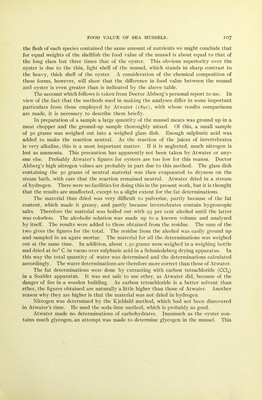
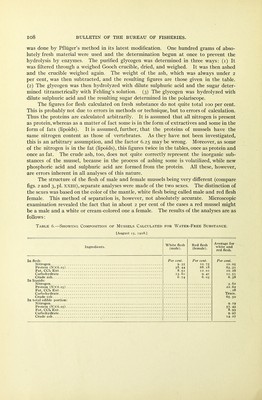
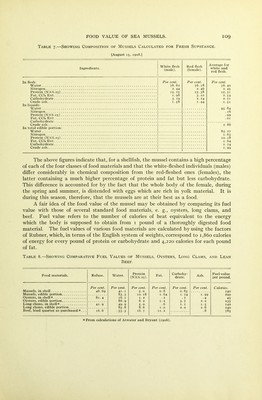
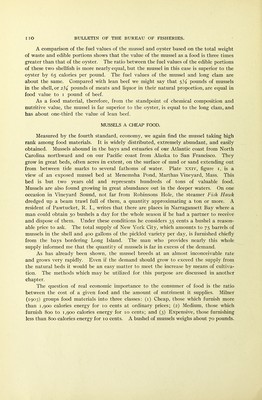
![was done by Pfliiger’s method in its latest modification. One hundred grams of abso- lutely fresh material were used and the determination begun at once to prevent the hydrolysis by enzymes. The purified glycogen was determined in three ways: (i) It was filtered through a weighed Gooch crucible, dried, and weighed. It was then ashed and the crucible weighed again. The weight of the ash, which was always under 2 per cent, was then subtracted, and the resulting figures are those given in the table. (2) The glycogen was then hydrolyzed with dilute sulphuric acid and the sugar deter- mined titrametrically with Fehling’s solution. (3) The glycogen was hydrolyzed with dilute sulphuric acid and the resulting sugar determined in the polariscope. The figures for flesh calculated on fresh substance do not quite total 100 per cent. This is probably not due to errors in methods or technique, but to errors of calculation. Thus the proteins are calculated arbitrarily. It is assumed that all nitrogen is present as protein, whereas as a matter of fact some is in the form of extractives and some in the form of fats (lipoids). It is assumed, further, that the proteins of mussels have the same nitrogen content as those of vertebrates. As they have not been investigated, this is an arbitrary assumption, and the factor 6.25 may be wrong. Moreover, as some of the nitrogen is in the fat (lipoids), this figures twice in the tables, once as protein and once as fat. The crude ash, too, does not quite correctly represent the inorganic sub- stances of the mussel, because in the process of ashing some is volatilized, while new phosphoric acid and sulphuric acid are formed from the protein. All these, however, are errors inherent in all analyses of this nature. The structure of the flesh of male and female mussels being very different (compare figs. 2 and 3, pi. xxiii), separate analyses were made of the two sexes. The distinction of the sexes was based on the color of the mantle, white flesh being called male and red flesh female. This method of separation is, however, not absolutely accurate. Microscopic examination revealed the fact that in about 2 per cent of the cases a red mussel might be a male and a white or cream-colored one a female. The results of the analyses are as follows: Table 6.—Showing Composition of Mussels Calculated for Water-Free Substance. [August 15, 1908.] Ingredients. White flesh (male). Red flesh (female). Average for white and red flesh. In flesh: Per cent. 9- 35 58. 44 8. SI 13. 61 6. 74 Per cent. 10. 75 68. 18 12.01 9. 41 6. 03 Per cent. 10. 05 63 - 3i 10. 26 11.51 6.38 3- 62 22. 62 . 28 Trace. 65-50 9- 19 57- 43 8. 93 9- 97 14. 27 In liquids: Fat, CCU Ext In total edible portion:](https://iiif.wellcomecollection.org/image/b21537616_0034.jp2/full/800%2C/0/default.jpg)