The food value of sea mussels / by Irving A. Field.
- Field, Irving Angell, 1870-1921.
- Date:
- 1911
Licence: In copyright
Credit: The food value of sea mussels / by Irving A. Field. Source: Wellcome Collection.
Provider: This material has been provided by The University of Leeds Library. The original may be consulted at The University of Leeds Library.
35/74 page 109
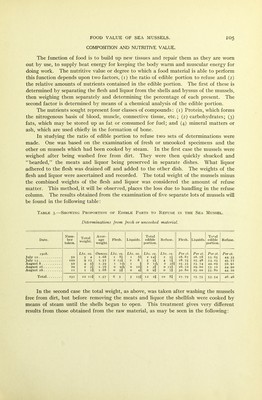
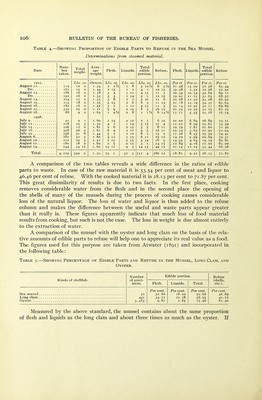
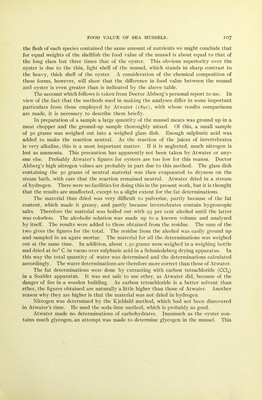
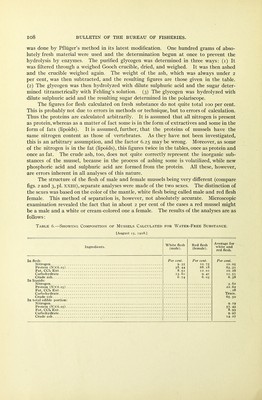
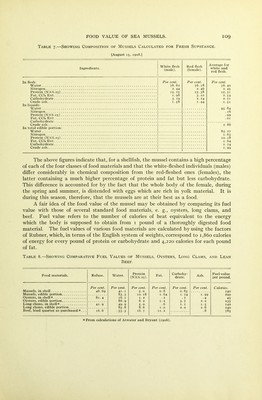
![Table 7.—Showing Composition of Mussels Calculated for Fresh Substance. [August 15, 1908.] Ingredients. White flesh (male). Red flesh (female). Average for white and red flesh. In flesh: Per cent. 76. 62 2. 44 15- 25 1.98 3- 19 1.58 Per cent. 76. 18 2. 46 15.38 3- 10 2. 24 I. 44 Per cent. 76. 40 2. 45 i5-3« 2- 54 2. 71 1.51 95.64 . 16 ■ 99 . 01 Fat, CCli Ext. In liquids: 2.86 83. 27 1.63 10. 18 1.64 1. 74 1.99 In total edible portion: The above figures indicate that, for a shellfish, the mussel contains a high percentage of each of the four classes of food materials and that the white-fleshed individuals (males) differ considerably in chemical composition from the red-fleshed ones (females), the latter containing a much higher percentage of protein and fat but less carbohydrate. This difference is accounted for by the fact that the whole body of the female, during the spring and summer, is distended with eggs which are rich in yolk material. It is during this season, therefore, that the mussels are at their best as a food. A fair idea of the food value of the mussel may be obtained by comparing its fuel value with those of several standard food materials, e. g., oysters, long clams, and beef. Fuel value refers to the number of calories of heat equivalent to the energy which the body is supposed to obtain from 1 pound of a thoroughly digested food material. The fuel values of various food materials are calculated by using the factors of Rubner, which, in terms of the English system of weights, correspond to 1,860 calories of energy for every pound of protein or carbohydrate and 4,220 calories for each pound of fat. Table 8.—Showing Comparative Fuel Values of Mussels, Oysters, Long Clams, and Lean Beef. Food materials. Refuse. Water. Protein (NX6.25). Fat. Carbohy- drate. Ash. Fuel value per pound. Per cent. 46. 69 Per cent. 41- 1 83.3 Per cent. Per cent. 0. 8 Per cent. 0. 85 1. 74 Per cent. Calories. 140 290 45 235 140 240 785 10. 18 1.64 1.99 81.4 86. 9 41.9 49- 9 85.8 55-3 . 6 8.6 Beef, hind quarter as purchased 0. . . 16. 6 16. 7 11. 2 .8 o From calculations of Atwater and Bryant (1906).](https://iiif.wellcomecollection.org/image/b21537616_0035.jp2/full/800%2C/0/default.jpg)