On the thermo-electric action of metals and liquids / by George Gore.
- George Gore
- Date:
- 1871
Licence: Public Domain Mark
Credit: On the thermo-electric action of metals and liquids / by George Gore. Source: Wellcome Collection.
Provider: This material has been provided by The Royal College of Surgeons of England. The original may be consulted at The Royal College of Surgeons of England.
19/26 page 339
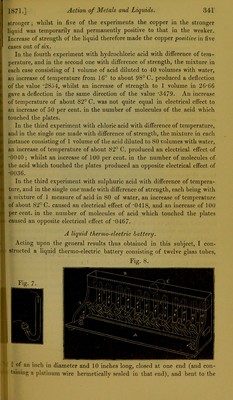
![flections, agreeing in direction with those of the other experiments, were obtained. These results show the necessity (which I have already mentioned) of excluding air-bubbles from beneath the copper dishes, and of not wetting the sides of the dishes by the liquid above the level of their immersion. To ascertain the influence of difference of temperature of the air-contact line I soldered two strips of perfectly similar sheet copper, each 12 inches i long and g inch wide, in the form of circular hoops 4 inches in diameter upon the bottoms of two tin cups, and ground the edges of the strips perfectly level, and soldered copper wires to them for connecting with the galvano- I meter. Two glass triangles were now put into the apparatus, fig. 1, one i in each dish, to support the cups, and a mixture of one measure of nitric i acid and 12 measures of distilled water poured in until it just touched the j edges all round of the perfectly horizontal copper rims resting on the tri- i angles. After the needles of the galvanometer had settled at zero, about j ten ounces of boiling water was poured into one of the cups; a temporary 1 deflection of the value '0560, and a permanent one of value ’0759, were « produced, the hot metal being negative. The direction of the current in this experiment agrees with that obtained with the same mixture and the ] copper dishes ; and the result indicates that a large proportion of the quan- ^ tity of the current obtained with copper dishes in dilute nitric acid was due ! to the action of the air-contact line. The influence of the air-line is largely chemical. “ A piece of copper iwire wholly submerged in the acid [dilute sulphuric] so as to entirely exclude any portion of it coming into contact with the air, has remained for many months without imparting the slightest tinge to the liquid.” “ But on suffering the liquid to evaporate so as to bring the upper end of 1 the metal near to its surface, the instant the slightest portion becomes ex- iK posed chemical action immediately begins.” [ “Two equal portions of wire were similarly placed in acid, only that one iv was fully exposed to the atmosphere in an open tube, while the other was llf placed in a phial, the acid occupying half its height, and was kept closely ic! corked for several weeks—after which the fully exposed metal had lost in a. weight two-fifths more than the one which had been excluded from contact fli with fresh portions of air, showing that-contact with the atmosphere in ti! bulk is necessary to the fullest action”*. Experiments with Liquids of unequal strength. To throw some light upon the questions,—1st, Is the quantity of the V current simply a result of the difference of number of molecules of liquid i which touch the hot plate compared with those which touch the cold i i plate ? and, 2nd, What amount of difference of strength of a liquid is equal t to the amount of difference of temperature employed ?—I brought the two * “ On the Theory of the Voltaic Pile,” Bridgman, Phil. Mag. Nov. 1869.](https://iiif.wellcomecollection.org/image/b22444117_0019.jp2/full/800%2C/0/default.jpg)