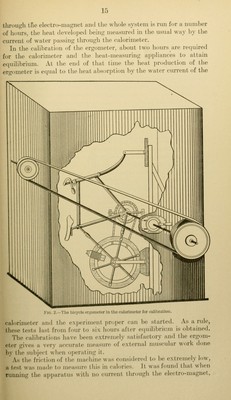
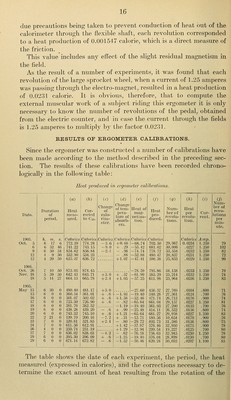
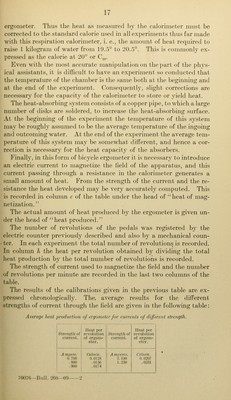
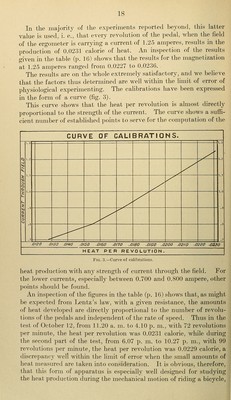
The influence of muscular and mental work on metabolism and the efficiency of the human body as a machine / By Francis G. Benedict ... and Thorne M. Carpenter.
- Francis Gano Benedict
- Date:
- 1909
Licence: Public Domain Mark
Credit: The influence of muscular and mental work on metabolism and the efficiency of the human body as a machine / By Francis G. Benedict ... and Thorne M. Carpenter. Source: Wellcome Collection.
Provider: This material has been provided by the Augustus C. Long Health Sciences Library at Columbia University and Columbia University Libraries/Information Services, through the Medical Heritage Library. The original may be consulted at the the Augustus C. Long Health Sciences Library at Columbia University and Columbia University.
50/110 (page 46)
![implied that so far as the carbon dioxid excretion is concerned the values found seemed to substantiate Lavoisier's view. The only factor measured was carbon dioxid, and Liebermeister admits that the results are not absolutely convincing. Physiologists for a long time attempted to establish some relation between brain and nerve activity and muscular work. When a muscle works heat is developed, and in the attempt to show the rela- tion between brain and nerve and muscles many experiments were made for the purpose of proving that heat is developed in a nerve when stimulated. For instance, Claude Bernard, using a thermo- electric needle for his measurements, reported such a development of heat. On the other hand, Heidenhain,6 Helmholtz,c and Rollestond were unable to demonstrate the formation of heat in nerves. The influence of muscular activity on body temperature has long been known, and many experiments have been made to determine whether mental work exercised a similar influence on body tempera- ture. John Davye made a large number of sublingual temperature observations on himself, and reports that during the evening sus- tained mental effort due to reading produced a slightly higher tem- perature than was normally obtained either when reading merely for amusement or when engaged in the mechanical process of copying. When residing in the Tropics Davy-* reports that mental exertion raised the body temperature 1.1° F. Rumpfs' observed that when he was reading between 9 and 12 in the evening the falling of the temperature curve which would nor- mally be expected did not occur. Speckh and Gley* also observed slight increases in temperature as a result of mental activity. Thus Speck reports that on three resting days his body temperature was 35.7°, 35.7°, and 35.8° C, while on days with mental activity the values were 35.9°, 35.8°, and 36° C, an increase so slight that he was inclined to attribute it wholly to minor differences in muscular activity. Allbutt, according to Pembrey/ records that a long series of observations failed to indicate that mental effort affected body tem- o Vorlesungen iiber der Thierische Warme. Trans, by Schuster, 1876, p. 151. Cited by Speck, Arch. Expt. Path. u. Pharmakol., 15 (1881), p. 87. b Stud. Physiol. Inst. Breslau, 4 (1868), p. 250. c Arch. Anat. Physiol, u. Wiss. Med., 1848, p. 158. d Jour. Physiol., 11 (1890), p. 208. « Phil. Trans., 1845, p. 319. /Ibid., 1850, p. 443. <7Arch. Gesam. Physiol., 33(1884), p. 601. ^Loc. cit. *Compt. Rend. Soc. Biol. [Paris], 1884, p. 265. 3 Textbook on Physiology, edited by E. A. Schafer, New York, 1898, Vol. I, p. 808.](https://iiif.wellcomecollection.org/image/b21228619_0050.jp2/full/800%2C/0/default.jpg)