Licence: Public Domain Mark
Credit: Sales catalogue: Sotheby's. Source: Wellcome Collection.
27/32 page 21
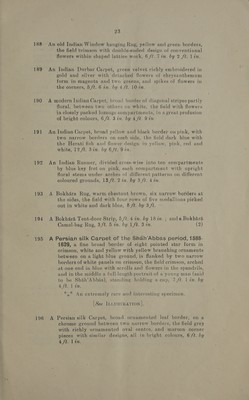
![173 175 177 2] _ A Cashmir Shawl, with embroidered design radiating from a circular centre, and euclosed by a cone border, 5 ft. 4in. by 5 ft. 2an. 7 A Cashmir Shawl, cream, with pale coloured cone design around a circular centre and corner pieces, within bordeis of floral pattern, 5/t. 6in. by 5/t. lin. A large Cashmir Shawl, green border, rosy red field with flowering scrolls and floral designs interspersed with variously shaped medallions and corner pieces, fringed with crimson, 22./¢. ll an. by 16 /¢. 7 in. A large Cashmir Shawl, deep rose border, green field with scrolled lattice and floral design interspersed with variously shaped medallions and corner pieces, fringed with crimson, 23 ft. 2in. by 15ft. 11 in. A large Cashmir Shaw! with five borders, the broadest with reversed cones, the field green with four rows of large circles enclosing smaller coloured circles having scrolled offshoots and large brightly coloured flowers, and with smaller flowers between, fringed crimson, 30/¢. by 15/t. 3 in. CARPETS. An Indian Carpet of the early 17th Century, crimson, two narrow borders on a white ground, flanking a broad border of upright flowering plants on crimson, the field de- corated length-wise with four rows of alternate flowering plants péd-a-péd, as in a garden, with a path down the middle, 13/t. 2in. by 6 ft. 1 in. x Abul-Fazl in his AKBAR-NAMAH tells us that prior to the time of Sultan Akbar no carpets were made in India, but were ordered from Kirman or Khurasan, until Akbar estab- lished State Factories for carpets on Persian models; but that it is from Shah Jahan’s time that most of the finest carpets were made. ‘his carpet is from the Indian State Factory at Amber, Jaipur (now a decayed town), where Akbar established one of the factories. It is illustrated in Martin’s “History of Oriental Carpets,” p. 100, fig. 243, and about it he writes: In this there are no European motives, but all are purely Kirman, though they have lost their strict [Persian] character.” As he had “ failed to find one authentic carpet of Akbar’s period,” this must be assigned to either the Jahangér or Shah Jahan periods : 1605-51. [See ILLUSTRATION |.](https://iiif.wellcomecollection.org/image/b31666097_0027.jp2/full/800%2C/0/default.jpg)

 No text description is available for this image
 No text description is available for this image
 No text description is available for this image