Volume 1
Elements of anatomy / / edited by William Sharpey, Allen Thomson, and Edward Albert Schafer.
- Jones Quain
- Date:
- 1878
Licence: Public Domain Mark
Credit: Elements of anatomy / / edited by William Sharpey, Allen Thomson, and Edward Albert Schafer. Source: Wellcome Collection.
Provider: This material has been provided by Royal College of Physicians, London. The original may be consulted at Royal College of Physicians, London.
33/720 (page 13)
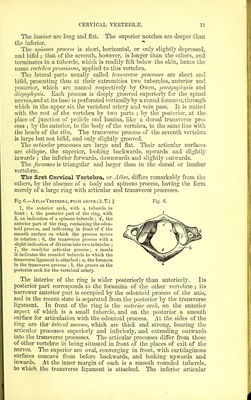
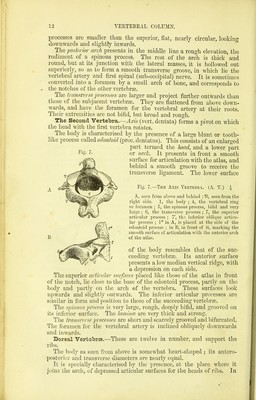
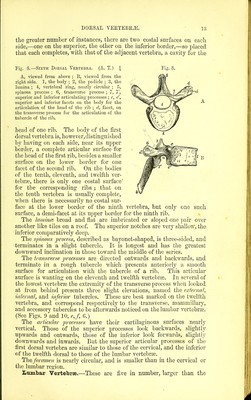
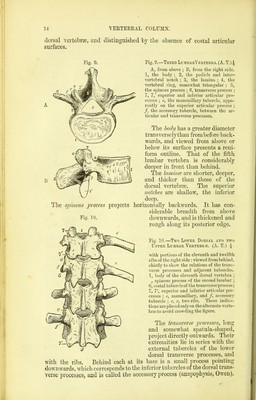
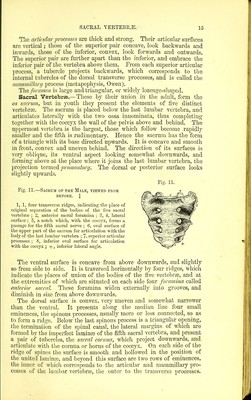
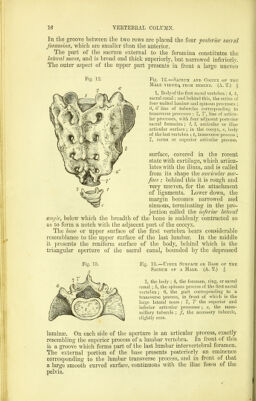
![DOESAL VERTEBliiE. IS the greater number of instances, there are two costal surfaces on each side,—one on the superior, the other on the inferior border,—so placed that each completes, with that of the adjacent vertebra, a cavity for the Fig. 8.—Sixth Dorsal Vertebra. (A. T.) A A, viewed from above ; 15, viewed from the riglit side. 1, the body ; 2, the pedicle ; 3, the lamina ; 4, vertebral ring, nearly eircuhir ; 5, si^inous process ; 6, transverse process ; 7, 7', superior and inferior articulating processes ; c, c', superior and inferior facets on the body for the articulation of the head of the rib ; d, facet, on the transverse process for the articulation of the tubercle of the rib. head of one rib. The body of the first dorsal vertebra is, however, distinguished by having on each side, near its upper border, a complete articular surface for the head of the first rib, besides a smaller surface on the lower border for one facet of the second rib. On the bodies of the tenth, eleventh, and twelfth ver- tebrae, there is only one costal surface for the corresponding ribs ; that on the tenth vertebra is usually complete, when there is necessarily no costal sur- face at the lower border of the ninth vertebra, but only one such surface, a demi-facet at its upper border for the ninth rib. The Jaminm broad and flat are imbricated or slo]3ed one pair over another like tiles on a roof. The superior notches are very shallow, the inferior comparatively deep. The sjnnous process, described as bayonet-shaped, is three-sided, and terminates in a slight tubercle. It is longest and has the greatest downward inclination in those toward the middle of the series. The transverse jirocesses are directed outwards and backwards, and terminate in a rough tubercle which presents anteriorly a smooth surface for articulation with the tubercle of a rib. This articular surface is wanting on the eleventh and twelfth vertebra3. In several of the lowest vertebrai the extremity of the transverse process when looked at from behind presents three slight elevations, named the external, internal, and inferior tubercles. These are best marked on the twelfth vertebra, and correspond respectively to the transverse, mammillary, and accessory tubercles to be afterwards noticed on the lumbar vertebrae. (See Figs. 9 and 10, e,f, G.) The articular processes have their cartilaginous surfaces nearly vertical. Those of the superior processes look backwards, slightly upwards and outwards, those of the inferior look forwards, slightly downwards and inwards. But the superior articular processes of the first dorsal vertebra are similar to those of the cervical, and the inferior of the twelfth dorsal to those of the lumbar vertebrae. lihe foramen is nearly circular, and is smaller than in the cervical or the lumbar region. lumbar Vertebrae.—These are five in number, larger than the](https://iiif.wellcomecollection.org/image/b24758280_0001_0033.jp2/full/800%2C/0/default.jpg)