Thirty-fourth annual report of the Malthusian League (founded 1877) : presented to the Members and Friends at the Annual Meeting on May 22nd, 1912 / by Alice Drysdale Vickery.
- Vickery, Alice Drysdale.
- Date:
- 1912
Licence: In copyright
Credit: Thirty-fourth annual report of the Malthusian League (founded 1877) : presented to the Members and Friends at the Annual Meeting on May 22nd, 1912 / by Alice Drysdale Vickery. Source: Wellcome Collection.
Provider: This material has been provided by The Royal College of Surgeons of England. The original may be consulted at The Royal College of Surgeons of England.
30/58
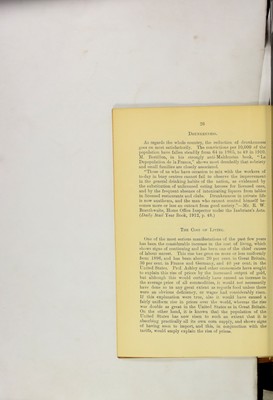
![Dkunkenness. As regards the wliole country, the reduction of drunkenness goes on most satisfactorily. The convictions per 10,000 of tlie ])opulation have fallen steadily from 64 in 1905, to 49 in 1910. M. Bertillon, in Ids strongly anti-Malthusian book, “La Depopulation de la France,” shows most decidedly that sobriety and small families are closely associated. “Those of us who have occasion to mix with the workers of to-day in busy centres cannot fail to observe the improvement in the general drinking habits of the nation, as evidenced by the substitution of unlicensed eating houses for licensed ones, and by the frequent absence of intoxicating liquors from tables in licensed restaurants and clubs. Drunkenness in private life is now anathema, and the man w'ho eannot control himself be- comes more or less an outcast from good society.”—Mr. R. W. Branthwaite, Home Office Inspector under the Inebriate’s Acts. {Daih/ Mail Year Book, 1912, p. 48.) The Cost of Living. One of the most serious manifestations of the past few years has been the considerable increase in the cost of living, which shows signs of continuing and has been one of the chief causes of labour unrest. This rise has gone on more or less uniformly from 1896, and has been about 20 per cent, in Great Britain, 30 per cent, in France and Germany, ami 40 i)er cent, in the United States. Prof. Ashley and other economists have sought to explain this rise of prices by the increased output of gold, but although this would certaiidy have caused an increase in the average price of all commodities, it would not necessarily have done so to any great extent as reg-irds food unless there w’^ere an obvious deficiency, or wages had considerably risen. If this explanation were true, also it would have caused a fairly unifoim rise in prices over the world, whereas the rise was double as great in the United States as in Great Britain, On the other hand, it is known that the population of the United States has now risen to such an extent that it is absorbing practically all its owm corn supply, and shows signs of having soon to import, and this, in conjunction with the tarill's, would amply explain the rise of prices.](https://iiif.wellcomecollection.org/image/b22480730_0032.jp2/full/800%2C/0/default.jpg)