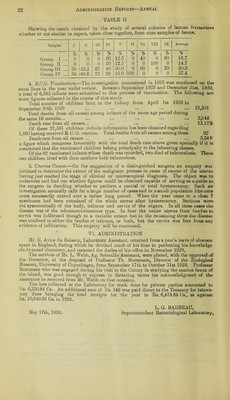
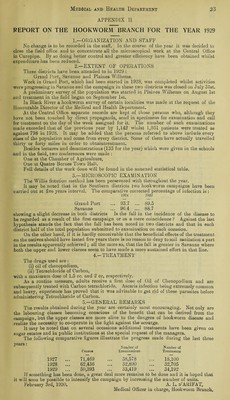
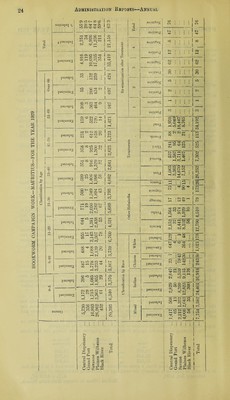
Annual report of the Director, Medical & Health Department / Colony of Mauritius.
- Mauritius. Medical and Health Department
- Date:
- [1929]
Licence: Public Domain Mark
Credit: Annual report of the Director, Medical & Health Department / Colony of Mauritius. Source: Wellcome Collection.
31/68 (page 21)
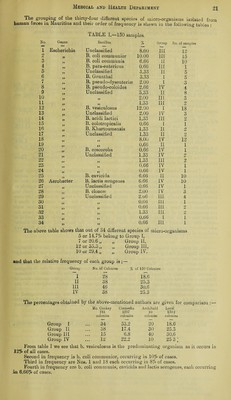
![The grouping of the thirty-four different species of micro-organisms isolated from human faeces in Mauritius and tbeir order of frequency is shewn in the following tables : TABLE I,—150 samples. No. Genus Bacillus % Group No. of samples 1 Escherichia Unclassified 8.00 III 12 9 99 B. coli communior 10.00 111 L5 3 99 B. coli communis 6.66 11 10 4 99 B. para-entericus 0.66 III 1 5 99 Unclassified 3.33 11 5 6 99 B. Grunthal 3.33 I 5 7 99 B. pseudo-dysenteriae 2.00 I 3 8 99 B. pseudo-coloides 2.66 IV 4 9 99 Unclassified 5.33 11 8 10 99 99 2.00 III 3 11 99 99 1.33 III 2 12 99 B. vesiculosus 12.00 I 18 13 99 Unclassified 2.00 IV 3 14 99 B. acidi lactici 1.33 III 2 15 99 B. colotropicalis 0.66 I 1 16 99 B. Khartournensis 1.33 II 2 17 99 Unclassified 1.33 II 2 18 99 99 8.00 IV 12 19 99 9 9 0.66 II 1 20 99 B. coscoroba 0.66 IV 1 21 99 Unclassified 1.33 IV 2 22 99 99 1.33 III 2 23 99 99 0.66 IV 1 24 99 99 0.66 IV 1 25 19 B. cavicida 6.66 H 10 26 Aerobacter B. lactis aerogenes 6.66 IV 10 27 99 Unclassified 0.66 IV 1 28 9) B. cloacae 2.00 IV 3 29 99 Unclassified 2.o6 III 4 30 99 >» 0.66 111 1 31 9 9 h 0.66 III 2 32 99 ti 1.33 III 2 33 99 1i 0.66 I 1 34 99 a 0.66 III 1 The above table shows that out of 34 different species of micro-organisms 5 or 14.7% belong to Group I, 7 or 20.6 „ „ Group II, 12 or 35.3 „ „ Group III, 10 or 29.4 „ „ Group IV. and that the relative frequency of each group is ;— Group No. of Colonies % of 150 Colonies I 28 18.6 11 38 25.3 III 46 30.6 IV 38 25.3 The percentages obtained by the above-mentioned authors are given for comparison :— Me. Conkey Ciemesha Archibald Local 241 1207 10 150], • colonies cplonies colonies colonies Group I 34 53.2 20 18.6 Group II 38 17.4 30 25.3 Group III 15 6.8 40 30.6 Group IV 12 22.2 10 25 3 ' From table I we see that b. vesiculosus is the predominating organism as it occurs in 12% of all cases. Second in frequency is b. coli communior, occurring in 10% of cases. Third in frequency are Eos. 1 and 18 each occurring in 8% of cases. Fourth in frequency are b, coli communis, cavicida and lactis aerogenes, each occurring in 6.66% of cases.](https://iiif.wellcomecollection.org/image/b31484189_0031.jp2/full/800%2C/0/default.jpg)