Mental work and fatigue and individual differences and their causes / by Edward L. Thorndike.
- Edward Thorndike
- Date:
- 1914
Licence: In copyright
Credit: Mental work and fatigue and individual differences and their causes / by Edward L. Thorndike. Source: Wellcome Collection.
Provider: This material has been provided by The University of Leeds Library. The original may be consulted at The University of Leeds Library.
50/434 page 32
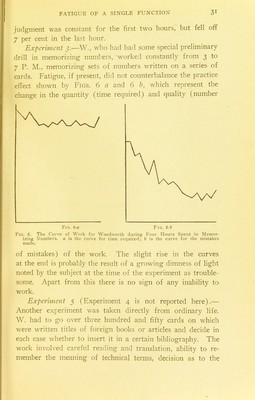
![fitness of the article and finally decision as to how to classify it. The work took three hours with thirty-five stops of from ten to fifteen seconds (to rest the subject’s eyes). The time taken to do each successive ten cards was recorded. No fatigue effect was observable. Fig. 7 shows the changes in the time required in the course of the experiment. Lindley’s [’00] three subjects gave as a median result for continuous adding for one hour the curve shown in Fig. 8, the fatigue effect of that much continuous exercise being fully counterbalanced by its practice effect. Bolton ['02, pp. 200 ff. and 226 ff.] found the number of additions in successive fifteen-minute periods of an hour to be for one subject as 100, 86, 82 and 75. In the case of two-hour periods with the same subject they were as 100, 86, 83, 81, 78, 75, 76 and 75. Kafemann [’02] worked at adding for ninety minutes on each of eight successive days, two five-minute rests being interspersed in each period. The work of the last five min- utes was only two per cent less than that of the first five minutes of the next day after full rest. Fleuman [’04], who had six subjects add for sixty min- utes (as in column addition, not passing 100), each one on a number of days, found the following proportions (Table 4)](https://iiif.wellcomecollection.org/image/b21524221_0050.jp2/full/800%2C/0/default.jpg)


 No text description is available for this image
 No text description is available for this image
 No text description is available for this image