A manual of chemistry : theoretical and practical, inorganic and organic, adapted to the requirements of students of medicine / by Arthur P. Luff and Hugh C.H. Candy.
- Arthur P. Luff
- Date:
- 1910
Licence: In copyright
Credit: A manual of chemistry : theoretical and practical, inorganic and organic, adapted to the requirements of students of medicine / by Arthur P. Luff and Hugh C.H. Candy. Source: Wellcome Collection.
Provider: This material has been provided by Royal College of Physicians, London. The original may be consulted at Royal College of Physicians, London.
59/644 (page 43)
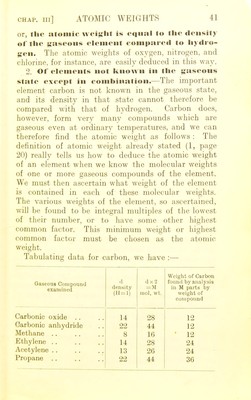
![chap, in] ISOMORPHLSM As the product, mass X specific heat, is the thermal capacity of the mass, Dulong and Petit really estab- lished the significant fact that all atoms have the same thermal capacity. Isomorphism.—A third method of determining atomic weights is based upon isomorphous relations as investigated by Mitscherlich. When different substances assume the same crystalline form, they are described as isomorphous. The isomorphism may be so perfect that a crystal of one substance will grow in a solution of the other, and crystals of mixed composition be obtained. When this happens the replacement of one substance by the other is always in molecular proportions, in accordance with Mitscherlich's law of iso- morphism. We therefore infer identity of atomic arrangement from identity of crystalline structure, and this may lead to a value of the atomic weight, as indeed it did in the case of gallium. Ex.—Gallium sulphate formed a double compound with ammonium sulphate, isomorphous with the alums, and therefore having, in all probability, the general formula M'2(S04)3. M'2S04. 24H20. In ammonium alum M' is NH4 and M' is Al. Therefore in the gallium compound M' is NH4 and M' is Ga. Analysis shows that the weight of gallium present in as much of this compound as contains 4(S04) is 138. But this must be, from analogy, two atoms. Therefore, the atomic weight of gallium must be (j'J. This value was afterwards confirmed by other methods. ABNORMAL MOLECULES M The relation A = which was arrived at on](https://iiif.wellcomecollection.org/image/b22651603_0059.jp2/full/800%2C/0/default.jpg)