Animal chemistry, or, Chemistry in its applications to physiology and pathology : part 1 / by Baron Liebig; edited from the author's manuscript by William Gregory.
- Liebig Justus Freiherr von, 1803-1873.
- Date:
- 1846
Licence: Public Domain Mark
Credit: Animal chemistry, or, Chemistry in its applications to physiology and pathology : part 1 / by Baron Liebig; edited from the author's manuscript by William Gregory. Source: Wellcome Collection.
Provider: This material has been provided by the Royal College of Physicians of Edinburgh. The original may be consulted at the Royal College of Physicians of Edinburgh.
18/289
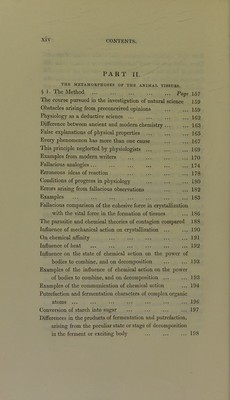
![PART II. THE METAMOHPHOSES OF THE ANIMAL TISSUES. § ]. The Method ... ... ... ... t<> Page 157 The course pursued in the investigation of natural science 159 Obstacles arising from preconceived opinions 159 Physiology as a deductive science ... ... ... ... 162 Difference between ancient and modem chemistry ... ... 163 False explanations of physical properties ... ... ... 165 Every phenomenon has more than one cause 167 This principle neglected by physiologists 169 Examples from modem writers ... ... ... ... 170 Fallacious analogies ... ... ... ... ... ... 174 Erroneous ideas of reaction ... ... ... ... 178 Conditions of progress in physiology ... ... ... 180 Errors arising from fallacious observations 182 Examples ... ... ... ... ... ... ... 183 Fallacious comparison of the cohesive force in crystallization with the vital force in the formation of tissues ... 186 The parasitic and chemical theories of contagion compared 188 Influence of mechanical action on crystallization ... ... 190 On chemical affinity ... ... ... ... ... 191 Influence of heat ... ... ... ... ... ... 192 Influence on the state of chemical action on the power of bodies to combine, and on decomposition ... ... 193 Examples of the influence of chemical action on the power of bodies to combine, and on decomposition ... ... 193 Examples of the communication of chemical action ... 194 Putrefaction and fermentation characters of complex organic atoms ... ... ... ... ... ... ... 196 Conversion of starch into sugar ... ... ... ...197 Differences in the products of fermentation and putrefaction, arising from the peculiar state or stage of decomposition in the ferment or exciting body ... ... ... 198](https://iiif.wellcomecollection.org/image/b21689155_0018.jp2/full/800%2C/0/default.jpg)
 No text description is available for this image
 No text description is available for this image
 No text description is available for this image