Thesaurus siluricus : the flora and fauna of the Silurian period : with addenda (from recent acquistions) / by John J. Bigsby.
- Date:
- 1868
Licence: Public Domain Mark
Credit: Thesaurus siluricus : the flora and fauna of the Silurian period : with addenda (from recent acquistions) / by John J. Bigsby. Source: Wellcome Collection.
Provider: This material has been provided by the Royal College of Physicians of Edinburgh. The original may be consulted at the Royal College of Physicians of Edinburgh.
47/284 (page 43)
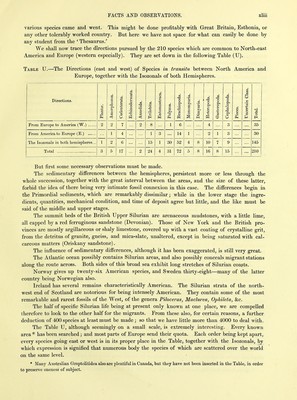
![various species came and went. This might be done profitably with Great Britain, Esthonia, or any other tolerably worked country. But here we have not space for what can easily be done by any student from the ' Thesaurus.^ We shall now trace the directions pursued by the 210 species which are common to North-east America and Europe (western especially). They are set down in the following Table (U). Table U.—The Directions (east and west) of Species in transitu between North America and Europe, together with the Isozonals of both Hemispheres. 03 O i a i 03 03 .2 03 o 03 Class. Directions. O g u (O 03 O 03 >^ _e3 O o a. O S 03 s Amorpl] Coelente Echinod Annelid Trilobit Entomo Polyzoa Brachio Monom^ Dimyar: Heterop Gastero; Cephalo Pisces. Uncerta Total. From Europe to America (W.) 2 2 7 2 8 1 6 4 3 35 From America to Europe (E.) 1 4 1 3 14 1 2 1 3 30 The Isozonals in both hemispheres... 1 2 6 15 1 30 52 4 8 10 7 9 145 Total 3 5 17 2 24 4 31 72 5 8 16 8 15 210 But first some necessary observations must be made. The sedimentary difiierences between the hemispheres, persistent more or less through the whole succession, together with the great interval between the areas, and the size of these latter, forbid the idea of there being very intimate fossil connexion in this case. The differences begin in the Primordial sediments, which are remarkably dissimilar; while in the lower stage the ingre- dients, quantities, mechanical condition, and time of deposit agree but little, and the like must be said of the middle and upper stages. The summit beds of the British Upper Silurian are arenaceous mudstones, with a little lime, all capped by a red ferruginous sandstone (Devonian). Those of New York and the British pro- vinces are mostly argillaceous or shaly limestone, covered up with a vast coating of crystalline grit, from the detritus of granite, gneiss, and mica-slate, unaltered, except in being saturated with cal- careous matters (Oriskany sandstone). The influence of sedimentary diff'erences, although it has been exaggerated, is still very great. The Atlantic ocean possibly contains Silurian areas, and also possibly conceals migrant stations along the route across. Both sides of this broad sea exhibit long stretches of Silurian coasts. Norway gives up twenty-six American species, and Sweden thirty-eight—many of the latter country being Norwegian also. Ireland has several remains characteristically American. The Silurian strata of the north- west end of Scotland are notorious for being intensely American. They contain some of the most remarkable and rarest fossils of the West, of the genera Piloceras, Maclurea, Ophileta, &c. The half of specific Silurian life being at present only known at one place, we are compelled therefore to look to the other half for the migrants. From these also, for certain reasons, a further deduction of 400 species at least must be made; so that we have little more than 4000 to deal with. The Table U, although seemingly on a small scale, is extremely interesting. Every known area * has been searched; and most parts of Europe send their quota. Each order being kept apart, every species going east or west is in its proper place in the Table, together with the Isozonals, by which expression is signified that numerous body the species of which are scattered over the world on the same level. * Many Australian Graptolitidea also are plentiful in Canada, but they have not been inserted in the Table, in order to preserve oneness of subject.](https://iiif.wellcomecollection.org/image/b21982648_0047.jp2/full/800%2C/0/default.jpg)