The inspection of meats for animal parasites / prepared under the direction of D.E. Salmon.
- Date:
- 1898
Licence: Public Domain Mark
Credit: The inspection of meats for animal parasites / prepared under the direction of D.E. Salmon. Source: Wellcome Collection.
102/172 (page 96)
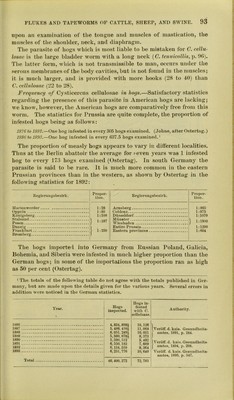
![21. The Thin, or Long, Necked Bladder Worm (Cysticercus tenuicollis) of Cattle, Sheep, and Swine, and its adult stage, The Marginate Tapeworm (Taenia marginata) of Dogs and Wolves. [Figs. 84-87A, 88, 89B, 90-93 ] Still another bladder worm, which is by no means uncommon in the animals of this country, occurs in the body cavity of cattle, sheep, swine, and other animals, attached to the dia- phragm, omentum, liver, or other organs. When eaten by dogs or wolves, it de- velops into the Marginate Tapeworm, which was formerly confused with T. solium of man, and gave rise to the er- roneous idea that the Pork-measle Tape- worm occurs in dogs as well as in man. Larval stage (Cysticercus tenuicollis). For anatomical characters, compare fig. 84 with key, p. 21. Synonymy.—Taenia hydatoidea Pallas, 1760; T. hydatigcna Pallas, 1766, pro parte; Hydra hydatula Linnaeus, (1766); Vermis resicularis eremita Bloch, 1782; Hydatigena orbicularis Goeze, 1782; H. globosa Batsch, 1786; H. oblonga Batsc-li, 1786; Vesicaria orbicularis Schrank, 1788; Taenia simiae Grnelin, 1790; T. ferarum Gmelin, 1790; T. caprina Gmelin, 1790; T. ovilla Gmelin, 1790; T. vervecina Gmelin, 1790; T. bovina Gmelin, 1790; T. apri Gmelin, 1790; T. globosa (Batsch) Gmelin, 1790; Hydatula solitaria Viborg, (1795); Cysticercus clavatus Zeder, 1803; C. sirniae (Gmelin) Zecler, 1803; C. caprinus (Gmelin) Zeder, 1803; C. tenuicollis Rudolphi, 1810; C. risceralis simiae Rudolphi, 1810 (T. simiae Gmelin, renamed); C. lineatus Laennec, 1812; C. ovis Cobbold, 1865; Monostomum hepaticum suis Willach, 1893; “ Cys- ticerkus” tenuicollis of Schneidemiihl, 1896. Prk-Linnaean names.—Hydatides Bartholini, 1673; Vermes vesiculares Hartmann (1685), quoted by Pallas as Hydatis animata; Lumbricus hydropicus, Tyson, 1691. Hosts.—Cattle, sheep, swine, deer, and other animals. (See pp. 137-143.) Fig. 83.—Half of hog, showing the por- tions most likely to become infested with pork measles. (After Ostertag, 1895, p. 387, fig. 79.) See p. 92. Adult stage (Taenia marginata Batsch, 1782). For anatomical characters, compare figs. 85-89 with key, p. 101. Synonymy.—See also pp. 89-90. Taenia solium Linnaeus, 1758, pro parte; T. cateni- formis Goeze, 1782, pro parte; T. marginata Batsch, 1782; T. lupina Schrank, (1788); T. cateniformis /i. lupi Gmelin, 1790; Halysis marginata (Batsch) Zeder, 1803; also UT. solium” of dogs, of several medical authors. Bibliography.—For technical discussion, see Deffke, 1891. Hosts.—Dog and wolf. (See pp. 137-143.)](https://iiif.wellcomecollection.org/image/b28132178_0102.jp2/full/800%2C/0/default.jpg)