The inspection of meats for animal parasites / prepared under the direction of D.E. Salmon.
- Date:
- 1898
Licence: Public Domain Mark
Credit: The inspection of meats for animal parasites / prepared under the direction of D.E. Salmon. Source: Wellcome Collection.
136/172 (page 130)
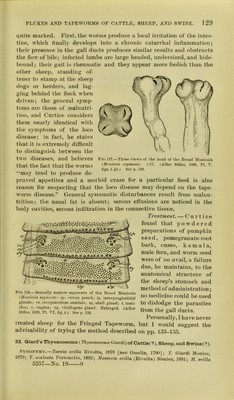
![vnr. macilenta Monies, 1891; Thysanosoma Giardi (Moniez) Stiles, 1893; Th. onlla (Rivoltu) Railliet, 1893; Taenia Brandti Cbolodkowsky, 1894; Th. ovillum, (Rivolta) Railliet, 1895. Ikis peculiar tapeworm lias been found in sheep in France, Italy, Germany, and Russia, and bas been recorded once in bogs; its occurrence as a normal ]>arasite in botli bogs and cattle is doubtful. (See pp. 126-127.) Genus STILESIA. 4 wo species of tbis genus are found in sbeep, but neither form is yet recorded for this continent. 33. TheGlobipunctate Stilesia (Stilesia globipunctata) of Cattle(?) and Sheep. Synonymy.— Taenia globipunctata Rivolta (1874); T. ovipunctata Rivolta (1874); Stilesia globipunctata (Rivolta) Railliet, 1893. Found in sbeep in Italy and India; its occurrence in cattle is doubtful. (See p. 126.) 34. The Centripunctate Stilesia (Stilesia centripunctata) of Cattle(?) and Sheep. Synonymy.—Taenia centripunctata Rivolta (1874); Stilesia centripunctata (Rivolta) Railliet, 1893; Taenia (Stilesia) centripunctata of Braun, 1895. Found in sbeep in Italy and Algeria; its presence in cattle is doubtful. (Seep. 126.) Fig. 119.—Gravid segment of the Broad Moniezia (Moniezia expansa), enlarged. (After Stiles, 1893, PI. YI, fig. 6.) See p. 328. Life history.—Nothing is positively known about the life history of any of the adult tapeworms of cattle or sheep; but from analogy we may assume that the life cycle is similar to that of other cestodes, namely, that the parasite runs through two stages—the adult form, in the intestine of cattle and sheep, and a larval state (a cysticercus or a cysticercoid), which will be found as a parasite in an intermediate host, probably some invertebrate animal, as an insect, snail, or worm. The intermediate host will become infected from the eggs in the faeces of the cattle and sheep, and the latter will become infected by accidentally swallowing the intermediate host. While this is what seems to us at present as the probable life history of the bovine and ovine tapeworms, it must be distinctly remembered that no one has as yet been able to positively make out the complete life cycle. In fact, some authors (Curtice and others) do not think that it is necessary for these worms to pass through any intermediate host, but they believe that the embryos (in the eggs) are swallowed by the cattle and develop directly into adult worms. This theory, however, is contrary to analogy, and although this Bureau has repeatedly attempted](https://iiif.wellcomecollection.org/image/b28132178_0136.jp2/full/800%2C/0/default.jpg)