The Peak guide, containing the topographical, statistical, and general history of Buxton, Chatsworth, Edensor, Castlteon [!] Bakewell, Haddon, Matlock, and Cromford; with an introduction giving a succinct account of the trade and manufactures of the county; an alphabetical list of noblemen and gentlemen's seats, and several road sketches ... / By Stephen Glover; edited by Thomas Noble, esq.
- Glover, Stephen, -1869.
- Date:
- 1830
Licence: Public Domain Mark
Credit: The Peak guide, containing the topographical, statistical, and general history of Buxton, Chatsworth, Edensor, Castlteon [!] Bakewell, Haddon, Matlock, and Cromford; with an introduction giving a succinct account of the trade and manufactures of the county; an alphabetical list of noblemen and gentlemen's seats, and several road sketches ... / By Stephen Glover; edited by Thomas Noble, esq. Source: Wellcome Collection.
37/196 (page 33)
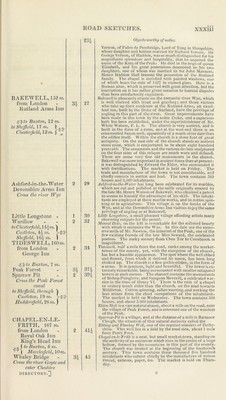
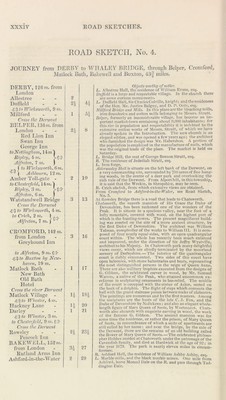
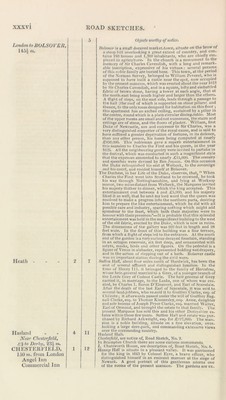
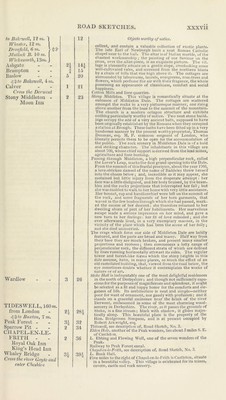
![BAKEWELL, 152 m. from London Rutland Arms Inn 4^3/0 Buxton, 12 vi. to Sheffield, 17 m. ) Chesterfield, 12 m. } fi Ashford-in-the-Water Devonshire Arms Inn Cross the river Wye Little Longstone - Ward low to Chesterfield, 14\m. 1 Castleton, 44 vi. • Sheffield, 16i m. f TIDESWELL, IfiOm. from London George Inn Jfi) to Buxton, 7 m. Peak Forest Sparrow Pit Cross the Peak Forest canal to Sheffield, through Castleton, 19 m. Huddersfield, 2S m. ?h ] *■ ■' 1 m. ) CHAPEL-EN-LE- FRITH, 167 m. from London Royal Oak Inn King’s Head Inn j to Buxton, 6 7n. 1 Macclesficld, 10 m, Whaley Bridge Cross the river Goyte and enter Cheshire DIRECTORY.^] 23| 34 27 2 29 ] 30 2 32 2 34 3-4 374 2 394 2 414 •u 45 Objects worthy of notice. Vernon, of Fulco de Pembridge, Lord of Tong in Shropshire, whose daughter and heiress married Sir Richard Vernon. Sir George Vernon, of Haddon, was so much distinguished for Ins magnificent splendour and hospitality, that he acquired the name of the King of the Peak. He died in the reign of queen Elizabeth, and his great possessions descended to his two daughters, one of whom was married to Sir John Manners. Hence Haddon Hall became the possession of the Rutland family. The chapel is enriched with painted windows, one of which bears the date of M27 in stained glass. Here is a Roman altar, which is preserved with great attention, but the inscription on it has rather given occasion to learned disputes than been satisfactorily explained. Bakewell is pleasantly situate on the romantic river Wye, which is well stocked with trout and grayling; and those visitors who take up their residence at the Rutland Arms, an excel- lent inn, built by the Duke of Rutland, have the privilege of angling in this part of the river. Great improvements have been made in this town by the noble Duke, and a capacious bath has been established, under the superintendence of Mr. White Watson, F. L. S. The church is very ancient, and is built in the form of a cross, and at the west end there is an ornamented Saxon arch, apparently of a much older date than the edifice itself. Within the church is a stone font of great antiquity. On the east side of the church stands an ancient stone cross, which is conjectured to be about eight hundred years old. The ornaments and the various devices sculptured on the four sides of this relique are much worn and defaced. There are some very fine old monuments in the church. Bakewell was more importantin ancient times than at present: it was distinguished by Edward the Elder, who surrounded it with fortifications. The market is held on Friday. The trade and manufacture of the town is not considerable, and chiefly consists in cotton and lead. The town contains 560 houses and 2,000 inhabitants. Ashford-in-the-Water has long been celebrated for its marbles, which are cut and polished at the mills originally erected by the late Mr. Henry Watson of Bakewell, who obtained a patent to secure to himself the advantages of his skill. The inhabi- tants are employed at these marble works, and in cotton spin- ning or in agriculture. This village is on the banks of the Wye, and at the Devonshire Arms Inn visitors enjoy the same privilege of angling as at Bakewell. Little Longstone, a small pleasant village affording artists many charming subjects for the pencil. Monsal Dale, on the left is remarkable for the softened beauty with which it embanks the Wye. In this dale are the exten- sive mills of Mr. Newton, the minstrel of the Peak, one of the few existing friends of the late Miss Seward, the celebrated poetess. The rocky scenery from Chee Tor to Cressbrook is magnificent. Tideswell, half a mile from the road, ranks among the market- towns of the county, yet, with the exception of the church, has but a humble appearance. The spot where the well ebbed and flowed, from which it derived its name, has been long choked up. The church is a fine gothic edifice, in the form of a cross. It is spacious, light and beautiful. The tower is ex- tremely remarkable, being surmounted with smaller octagonal towers at each corner. The chancel contains the monuments of Bishop Pursglove, and Sampson Meverill, a celebrated war- rior in the time of Henry VI. There isthernin of a chapel or oratory much older than the church, on the road towards Middleton. Cotton spinning, calico weaving, and working the lead mines form the chief occupations of the inhabitants. The market is held on Wednesday. The town contains 500 houses, and about 3,000 inhabitants. Elden Hole is a vast natural chasm, about a mile on the road, near the village of Peak Forest, and is esteemed one of the wonders of the Peak. Sparrow-Pit is a village, and at the distance of a mile is Barmoor Clough, the situation of that natural curiosity called the Ebbing and Flowing Well, one of the reputed wonders of Derby- shire. This well lies in a field by the road side, about 1 mile from Perry Foot. Chapel-en-le-Frith is a neat, but small market-town, standing on the acclivity of an eminence which rises in the centre of a large hollow, formed by the mountains in this part of the county. The church was erected at the beginning of the fourteenth century. This town contains three thousand five hundred inhabitants who subsist chiefly by the manufacture of cotton thread, calicoes, paper, &c. The market is held on Thurs- day. C](https://iiif.wellcomecollection.org/image/b29291963_0037.jp2/full/800%2C/0/default.jpg)