Licence: Public Domain Mark
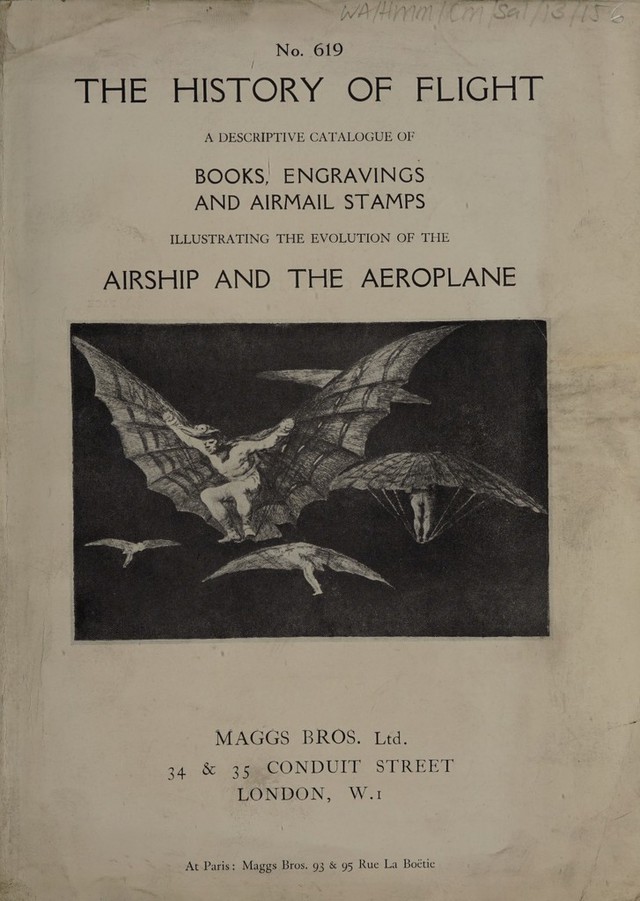
Credit: Sales catalogue 619: Maggs Bros. Source: Wellcome Collection.
11/236 page 9
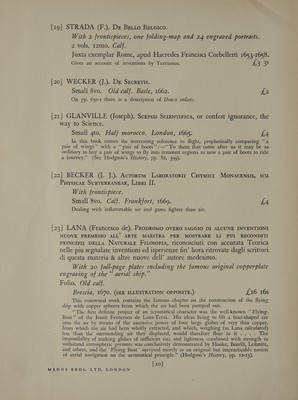
![; FORBIDDEN BY THE POPE. [14] WILKINS (John, Bishop of Chester). THe Discovery or a WoRLD IN THE Moone. Or, A Discourse tending to prove that ’tis probable there may be another habitable World in that Planet. Scarce First Eprtion. 12mo. Calf. London: E. G. for Michael Sparke and Edward Forrest, 1638. £6 6s This scarce little work was forbidden by Papal Decree, April 25, 1701. Wilkins obtained several hints for his work, from the notable “‘Man in the Moone” (1638) by Bishop Francis Godwin. There can be little doubt that the hero of Robert Paltock’s “Peter Wilkins”? derived his name from our author. “The writings of Bishop Wilkins were amongst the earliest printed works in which the “Art of Flying” was theoretically considered as a scientific problem .. . These novel ideas made a deep impression on his own age. Broadly speaking, Wilkins dealt with winged flight after the manner of birds, and... . suggested that it might be possible to use both legs and arms. But his ideas went beyond the mere conception of human flight, and in discussing the possibilities of making a ‘flying chariot,’ he raised questions as to the relative length and breadth of the wings, the weight and necessary strength thereof, as well as the need of control, and he even ventured so far as to suggest the use of mechanical power.” (Hodgson’s History, p. 10). Margin of last leaf repaired, not, however, affecting the text. Slight stains. {15] SWAN (ohn). Specutum Munot, or a glasse representing the face of the World. Small 4to. Half calf. Cambridge, R. Daniel, 1643. £4 Early meteorological book with an explanation of Flying Dragon, etc. {16] CRISPOLTI (Cesare). PErucia Avucusta. Small 4to. Old vellum. Perugia, 1648. £6 Ios An account of Giovanni Battista Danti’s, the mathematician of Perugia, alleged flight over the lake of Trasimeno in Umbria in 1490. {17] BIEDERMAN JJ.). Urorta. 12mo. Calf. Cologne, 1649. £2 10s In this Utopia there are the following interesting features:—A tragic demonstration of a flight by an aviator; and an air combat in which a flying dragon is engaged. [18] GAFFAREL (James). UnnEarp-oF Curiosities. Translated from the French by Edmund Chilmead. Small 8vo. Old calf. London, Printed for G. D., 1650. £2 Ios Mentioning the art of flying and giving also an account of Archytas of Tarentum (fl. 4oo B.C.) and his “flying pigeon.” [9]](https://iiif.wellcomecollection.org/image/b31641362_0011.jp2/full/800%2C/0/default.jpg)

 No text description is available for this image
 No text description is available for this image
 No text description is available for this image