Licence: Public Domain Mark
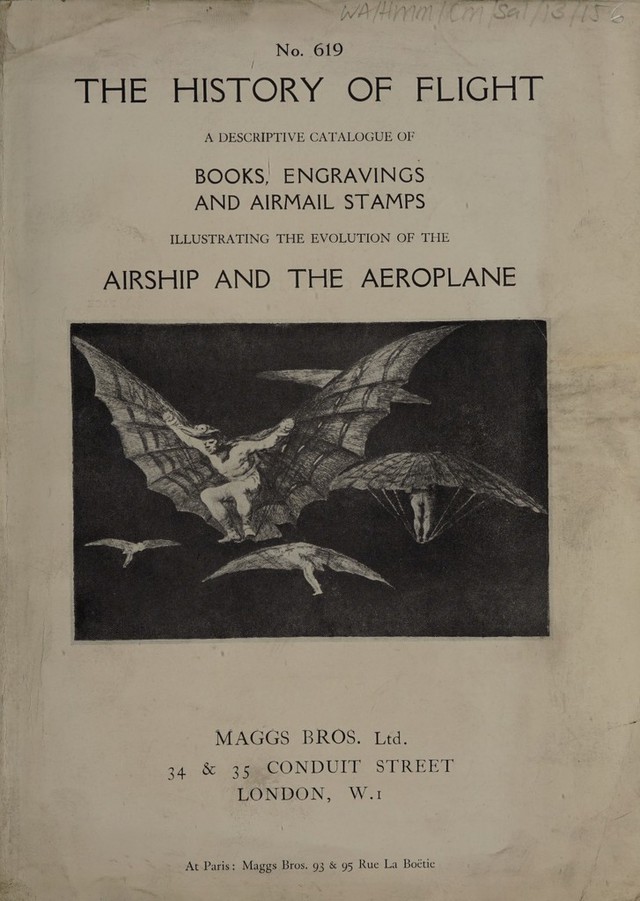
Credit: Sales catalogue 619: Maggs Bros. Source: Wellcome Collection.
12/236 page 10
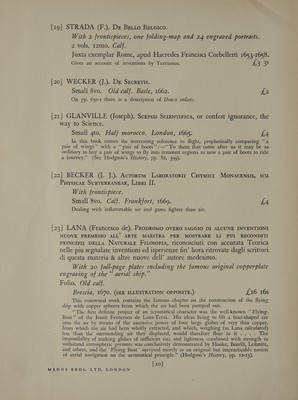
![[19] STRADA (F.). De Beto Betcico. With 2 frontispieces, one folding-map and 24 engraved portraits. 2 vols. 12mo. Calf. Juxta exemplar Rome, apud Haeredes Francisci Corbelletti 1653-1658. Gives an account of inventions by Turrianus. 3 38 [20] WECKER (J.). De Srcretis. Small 8vo. Old calf. Basle, 1662. piss On pp. 650-1 there is a description of Draco volans. [21] GLANVILLE (Joseph). Scepsis ScrentiFica, or confest ignorance, the way to Science. Small 4to. Half morocco, London, 1665. £4 In this book comes the interesting reference to flight, prophetically comparing “a pair of wings” with a “pair of boots” :—‘‘To them that come after us it may be as ordinary to buy a pair of wings to fly into remotest regions as now a pair of boots to ride a journey.” (See Hodgson’s History, pp. 82, 399). [22] BECKER JJ. J.). Acrorum Lasporatorir CHymicr MONACcENsIs, seu PHystcaE SUBTERRANEAE, List II. With frontispiece. Small 8vo. Calf. Frankfort, 1669. £4 Dealing with inflammable air and gases lighter than air. [23] LANA (Francesco de). PRoDROMO OVERO SAGGIO DI ALCUNE INVENTIONI NUOVE PREMESSO ALL’ ARTE MAESTRA PER MOSTRARE LI PUI RECONDITI PRINCIPII DELLA NATURALE FILOSOFIA, riconosciuti con accurata Teorica nelle piu segnalate inventioni ed isperienze fin’ hora ritrovate dagli scrittori di questa materia & altre nuove dell’ autore medesimo. With 20 full-page plates including the famous original copperplate engraving of the “ aerial ship.” Folio. Old calf. Brescia, 1670, (SEE ILLUSTRATION OPPOSITE.) £16 16s This renowned work contains the famous chapter on the construction of the flying ship with copper spheres from which the air had been pumped out. ‘The first definite project of an aerostatical character was the well-known “ Flying- Boat” of the Jesuit Francesco de Lana-Terzi. His ideas being to lift a boat-shaped car into the air by means of the ascensive power of four large globes of very thin copper, from which the air had been wholly extracted, and which, weighing (as Lana calculated) Jess than the surrounding air they displaced, would therefore float in it... . The impossibility of making globes of sufficient size and lightness, combined with strength to withstand atmospheric pressure was conclusively demonstrated by Hooke, Borelli, Leibnitz, and others, and the ‘ Flying Boat’ survived merely as an original but impracticable notion of aerial navigation on the aerostatical principle.” (Hodgson’s History, pp. 12-13). [10]](https://iiif.wellcomecollection.org/image/b31641362_0012.jp2/full/800%2C/0/default.jpg)

 No text description is available for this image
 No text description is available for this image
 No text description is available for this image