Licence: Public Domain Mark
Credit: Sales catalogue 619: Maggs Bros. Source: Wellcome Collection.
123/236 page 121
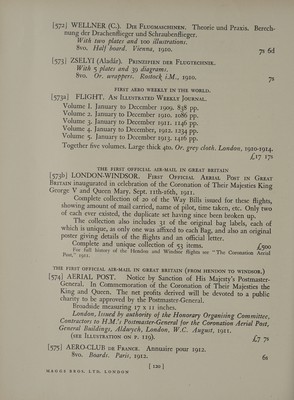
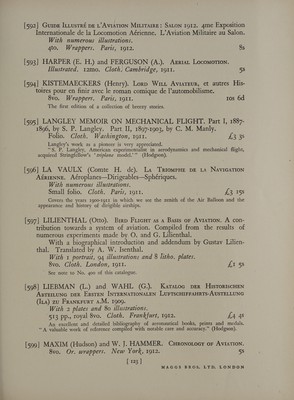
![[575a] GREY (Chas. G.). Tue’ AEROPLANE. Profusely illustrated. ol. 1. June 8th, 1911—December 29th, 1911. Nos. 1-30. Vol. 2. January 4th, 1912—June 27th, 1912. Nos. 31-56. Vol. 3. July 4th, 1912—December 26th, 1912. Nos. 1-25. Vol. 4. January 2nd, 1913—June 26th, 1913. Nos. 1-26. Vol. 5. July roth, 1913—December 25th, 1913. Nos. 2-26. Vol. 6. January rst, 1914—June 25th, 1914. Nos. 1-26. Vol. 7. July rst, 1914—December 30th, 1914. Nos. 1-27. Vol. 8. January 6th, 1915—June 30th, 1915. Nos. 1-26. Vol. 9. July 7th, 1915—December 29th, 1915. 9 volumes in all. Small folio. Green cloth. London, IQII-1915. £6 6s [576] AERONAUTICS. A Monruty JOURNAL DEVOTED TO THE TECHNIQUE oF Arronautics. Volume V. Nos. 47-58. With numerous folding plates and illustrations. 4to. Cloth. London, January 1912—December 1912. Lp) [577] AMBROSINI (Raimondo). L’ArREonautica a BoLocna. With 14 reproductions af old and modern engravings. Royal 8vo. Wrappers. Bologna, 1912. 15s An interesting account of the aeronautical history of Bologna, and some of its famous Airmen from Zambeccari to Testi. [578] BAGUE (E.). MEs PREMIERES IMPRESSIONS D’AVIATEUR. 8vo. Paris, 1911. 38 [579] BAUENDAHL (Oskar). Diz GeHEIMNIssE pes Ftucrs. Der Gegen- druck gegen Luftleere. 8vo. Or. wrappers. Berlin, 1911. 6s A ° . [580] [GUSMAO (B. L.), 1685-1724, Inventor of an aeronautical machine, Passarola.| FARIA (Vicomte de). BarrHoLomMeu LourENco pE GusmAo (1685-1724) inventeur des Aérostats. With illustrations. 8vo. Wrappers. Lausanne, I91l. 1os 6d En commémoration du 202e Anniversaire de la premiére ascension publique faite 4 Lisbonne, le 8 aofit 1709. ; “Whether the ‘flying: boat’ alleged to have been invented at Lisbon in 1709 by a: Brazilian priest, Bartholomeu Lourengo de Gusmao (1685-1724), was of that character, has not certainly been determined—indeed, the whole matter is one of doubt and controversy. Gusmao’s ‘passarola’—the suggestion of swallow-like flight cannot have been sustained otherwise than in the name—apparently combined in the body of the machine, the use of wings (or feathers), the attractive power of magnets, and possibly the levity of rarified air, while above the whole was a sail presumably designed to act somewhat in the nature of a parachute. The project is well known from the contemporary engravings, but beyond the fact that the inventor imposed his invention on the credulity of the King of Portugal with pecuniary success, there is little authority for regarding it seriously.” (See Hodgson’: History, p. 13). Pir2tot](https://iiif.wellcomecollection.org/image/b31641362_0123.jp2/full/800%2C/0/default.jpg)
 No text description is available for this image
 No text description is available for this image
 No text description is available for this image