Licence: Public Domain Mark
Credit: Sales catalogue 619: Maggs Bros. Source: Wellcome Collection.
7/236 page 5
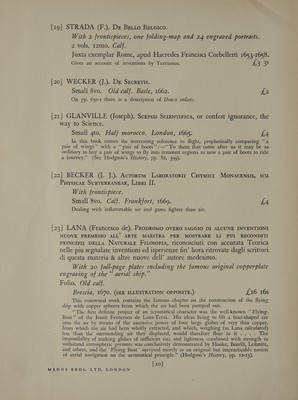
![AERONAUTICS Part I. Books. [arranged in chronological order | [1] SUETONIUS (Tranguillus). Vrraz x11. CazsaRuM. Small folio. Old calf, |Treviso, Johannes Rubeus|, 1480. £20 Suetonius describes a spectacle given before Nero (A.D. 57) which included a flying man; unfortunately “‘Icarus, upon his first attempt to fly, fell on the stage close to the emperor’s pavilion and bespattered him with blood.” Hain 15119. See also Hodgson’s History of Aeronautics, p. 6. [2] LUCIAN. Icaromentrpus, seu Hypernephelus (in Greek and Latin). 8vo. Old calf (rebacked ). Basle, 1524. £10 Contains the first story of a Flying Man. [3] BACON (Roger). DE MIRABILI POTESTATE ARTIS ET NATVRAE. First Eprtion. Sm. 4to. Vellum. Paris, Simon de Colines, 1542. 448 “Flying,” see folios 42. The rare First Edition. “Roger Bacon was probably the first Englishman to write on the subject in any mechanical or scientific sense—certainly his are the oldest extant speculations. . . . In ‘The Secrets of Art and Nature’ (written about 1250), he sought—to quote the trans- lation in the Oxford volume of ComMmEMoraTIon Essays oN RocER Bacon, 1914—to ‘demonstrate the inferiority and indignity of magical power to that of Nature and Art,’ by discoursing ‘on such admirable operations of Art and Nature as have not the least magick in them.’ Dealing first ‘of such Engines as are purely artificial,’ he says it is possible to make a chariot move ‘ with an inestimable swiftness . . . and this motion to be without the help of any living creature.’ “Then follow two short passages of great interest in the early annals of aeronautics, if only by reason of their appearance in the thirteenth century. They occur in the chapter ‘Of Admirable Artificial Instruments,’ and may be quoted in the quaint language of an early English translation. ‘It’s possible,’ wrote Bacon, ‘to make Engines for flying, a man sitting in the midst thereof, by turning onely about an Instrument, which moves artificial Wings made to beat the Aire, much after the fashion of a Bird’s flight.’ Having described other mechanical devices, Bacon states that all of them have been actually constructed, with the notable exception of ‘only that instrument of flying, which I never saw or know any who hath seen it, though I am exceedingly acquainted with a very prudent man, who hath invented the whole Artifice.’”” (Hodgson’s History of Aeronautics, pp. 68-69). |4] GRAFTON’S AsripGEMENT OF THE CHRONICLES OF ENGLAND TO I570. 12mo. Old calf. London, 1570. £4 4s Containing a History of Bladud, the flying King of Bath, 852 B.C. The beginnings of aeronautical history in Great Britain open with the legend of the winged flight . . . of Bladud. This story of the mythical tenth King of Britain was first printed in 1508 in Geoffrey of Monmouth’s History. See also Hodgson’s History of Aeronautics, p. 53- (Title defective). Lise](https://iiif.wellcomecollection.org/image/b31641362_0007.jp2/full/800%2C/0/default.jpg)

 No text description is available for this image
 No text description is available for this image
 No text description is available for this image