Volume 1
Census of England and Wales, 1911 (10 Edward 7 and 1 George 5, ch. 27.).
- Great Britain. Census Office.
- Date:
- 1912-23
Licence: Public Domain Mark
Credit: Census of England and Wales, 1911 (10 Edward 7 and 1 George 5, ch. 27.). Source: Wellcome Collection.
13/1138
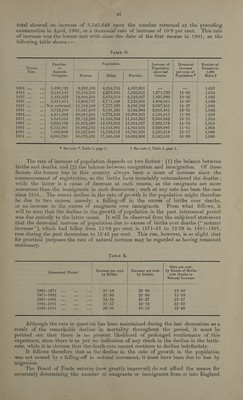
![separate occupiers will be given as hitherto for each area of every class dealt with, but returns of buildings will be presented only for Urban and Rural Districts. For these areas, however, the various kinds of buildings will be classified in such detail as to do away with the objectionable indefiniteness of the previous returns. Buildings, whether designed for habitation or not, will be classified according to their nature, and the population enumerated in each type of building will be stated. It will be shown for instance how many blocks of flats are contained in a given town, how many separate flats or tenements are contained in these blocks, and what is the popula- tion inhabiting them. These returns will constitute the fifth volume relating to popula- tion statistics, referred to on page vy. ‘Number of Families—As in the case of previous censuses, the figures given in the column for “ Families or Separate Occupiers” throughout the tables correspond with the number of schedules collected, and therefore include not only the numbers of private families, but also the numbers of institutions, large private establishments, vessels, caravans, &c., in each area, This practice obviously renders it impossible to obtain the number of private households or the average number of persons to a private family. With a view to obtaining this information while retaining the figures relating to ‘‘ families or separate occupiers” for comparison with those for the previous censuses, two new columns have been introduced into Table 10 in this volume, showing for each Urban — and Rural District and Civil Parish the aggregate number of institutions, large establish- ments, vessels, &c., and the population enumerated therein. By deducting these numbers from the total number of schedules collected and from the total population enumerated, the approximate number of private families and the number of persons comprised in such families can be ascertained. The population of England and Wales at the date of the census of 1911 numbered 36,070,492, enumerated on 8,005,290 schedules; of these, 34,630 schedules, (representing a population of 1,294,090 persons) related to institutions, large establishments, &c. The approximate number of private families in England and Wales was therefore 7,970,660, comprising a population of 34,776,402, and the average number of persons in such families was 4:4. A closer estimate of the number of private families in Urban and Rural Districts will be obtainable from the statistics as to “'Tenements” to be published later. Density of Population—The aggregate area of England and Wales, including land and inland water but excluding tidal water and foreshore, is 37,337,537 statute acres, or 58,340 square miles. The total population at the date of the census was 36,070,492, and therefore, assuming even distribution of the population over the entire area, each square mile would have been occupied by 618 persons. The gradual increase of density of population in this country at each successive census 1s shown in the subjoined statement. | The last column refers to the distance which would separate each individual inhabitant from his nearest neighbour if all were distributed at equal intervals over the whole surface of the country. TABLE B. Persons per Acres per | Proximity in Dale of Congus. Square Mile. | Pend ‘pets 1801 a ie ae il by; 4°20 153 ISDL 6) sds east 174 3°67 143 S21 Ace by oe 206 3°11 132 LR yon RR 2 aa sae 238, 4 2°69 123 toy: 3 ee if els 273 2°00 114 1851 \.: he yl 307 2°08 108 1861 ... oad veal 344 1°86 102 LAT a ass ae aoe 389 1°64 96 i heat}! yee oh vee] 445 1°44 90 TROECH? ate oat 497 1°29 85 1901. ... ioe bas 558 1 80 TODD Boy bbe oe 618 1°04 76 The following table relates to Administrative Counties together with, in the case of each, any County Boroughs associated with the County (ze., in the terms of the Local Government Act of 1888, deemed for the purpose of that Act to be situate therein) and indicates the density of population in each of these areas :—](https://iiif.wellcomecollection.org/image/b32183185_0001_0013.jp2/full/800%2C/0/default.jpg)