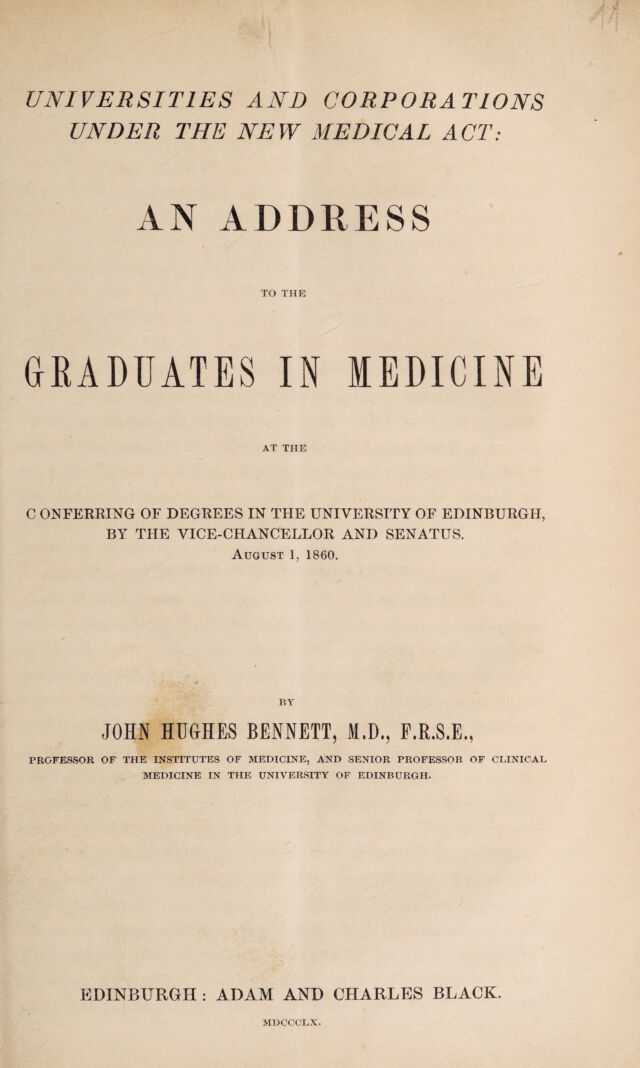
Universities and corporations under the new Medical Act : an address to the graduates in medicine at the conferring of degrees in the University of Edinburgh by the Vice-Chancellor and Senatus, August 1, 1860 / by John Hughes Bennett.
- John Hughes Bennett
- Date:
- 1860
Licence: Public Domain Mark
Credit: Universities and corporations under the new Medical Act : an address to the graduates in medicine at the conferring of degrees in the University of Edinburgh by the Vice-Chancellor and Senatus, August 1, 1860 / by John Hughes Bennett. Source: Wellcome Collection.
12/24 page 12
![They must, therefore, at some period confide their lives to the skill and attention of the medical man.] For him is then raised the veil which screens the privacy of domestic life, and to him, in many instances not only is the peace and happiness, but the interests and honour of families, entrusted. The patient has no knowledge of his malady, nor of the conformation of that wonderful struc¬ ture which is prostrated by disease. Yet so interested, although so ignorant, are mankind in all that concerns their health, that their confidence is constantly abused by designing persons. Any presumptuous man who assumes the title of doctor, by telling im¬ pressionable persons that some bodily organ is disordered, may strongly operate on their imaginations and influence their feel¬ ings. In this manner such persons may be rendered uneasy and miserable, though nothing be visible, tangible, or perceptible to their senses. Not unfrequently, ruin to the peace of entire families has thus been produced. The public, then, are especially interested in seeing that the man who possesses so much power, possesses also the knowledge and character to use it properly; and every Government that watches over the welfare of a people is bound to regulate the qualifications of those who practise medicine under its sway. These views becoming more general, a bill at length passed the Legislature in 1858, which abolished the territorial privileges of the corporations, and permitted every medical man to practise, according to his qualification or qualifications, throughout the kingdom. It empowered a Council to be formed of delegates from the various universities and corporations—a sort of medical parliament—which was to settle the details of all vexed ques¬ tions. It ordered the preparation and publication of a Register of legally qualified practitioners, and of a national Pharmacopoeia; and provided that the licentiates and fellows of a college in one part of the country, who might desire to join another in a dif¬ ferent part of it, might do so on the payment of a small sum (L.2). In this manner the evils resulting from local privileges and jurisdiction were to a great extent removed. Other dis-](https://iiif.wellcomecollection.org/image/b30564402_0012.jp2/full/800%2C/0/default.jpg)