Appendix to Down Bros.' catalogue of surgical instruments and appliances : Octoberr 1910 / Down Bros., Ltd.
- Down Bros. (Firm)
- Date:
- 1910
Licence: In copyright
Credit: Appendix to Down Bros.' catalogue of surgical instruments and appliances : Octoberr 1910 / Down Bros., Ltd. Source: Wellcome Collection.
190/264 page 182
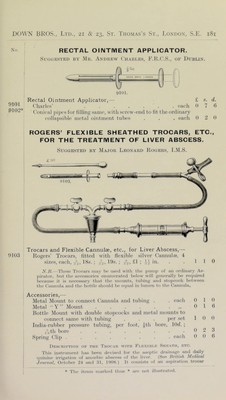
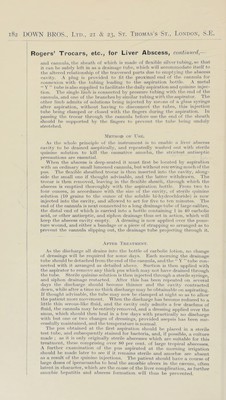
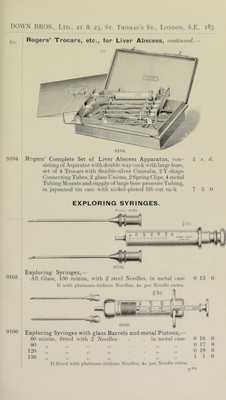
![Rogers’ Trocars, etc., for Liver Abscess, continued,— and cannula, tlie slieatli of which is made of flexible silver tubing, so that it can bo safely left in as a drainage tube, which will accommodate itself to the altered relationship of the traversed parts due to empt3'ing the abscess eavit^^ A plug is provided to fit the proximal end of the cannula for connexion with the tubing leathng to the asj^iration bottle. A metal “ Y ” tidje is also supplied to facilitate the daily aspiration and quinine injec- tion. The single limb is connected l^y pressure tidhng with the end of the cannula, and one of the brandies b^'similar tubing with the aspirator. The othei- limb admits of solutions being injected by means of a gla.ss sjTinge after aspiration, witliout liaving to disconnect tlie tubes, this injection tube being clamped or closed witli the fingers during the aspiration. In passing the trocar tlirough the cannula before u.se the end of the slieath should bo supported by tlie fingers to ]irevent the tidie being unduly stretched. IMethod of U.SE. -As the whole principle of the instrument is to enable a liver abscess ca^dt5^ to be drained asepticall3^ and repeatedly washed out with stoi'ile quinine solution to kill the causative amoeba, the sti'ictest antisejitic precautions are essential. When the abscess is deep-seated it must first be located b\' aspiraHon with an ordinaiy small lumened cannula, but without removing much of the pus. 'I'he flexible sheathed trocar is tlien inserted into the ca^ itv, along- side the small one if thought advisable, and the latter withdrawn. The trocar is then removed, leaving in the flexible slieath, througli which the abscess is emptied thoroughly witli the aspiration bottle. From two to four ounces, in accordance with the size of the cavity', of sterile quinine solution (10 grains to the ounce of the soluble bi-h\-drochloride) is now injected into the cavity, and allowed to act for five to ten minutes. The end of the cannula is next connected to a long drainage tube of large calibre, the distal end of which is carried into a bottle containing 1 in 40 carbolic acid, or other antiseptic, and siphon drainage thus set in action, which will keep the abscess cavitj^ eniptj'. A dressing is now applied over the punc- ture wound, and either a bandage or a piece of strapjiing so ari'anged as to prevent the cannula slipping out, the drainage tube projecting through it. After 'Pre.^tment. .As the discharge all drains into the bottle of carbolic lotion, no change of dressings will be required for some days. Each monuiig the drainage tube should bo detached from the end of the cannula, and the “ Y ” tube con- nected with it arranged as detailed above. Suction is then applied with the aspirator to remove anj’ thick ])us which may' not have drained through the tube. Sterile quinine solution is then injected through a sterile svringe, and siphon drainage restarted. .After this has been re])eatod on several days the discharge should become thinner aufl the cavitv contracted down, while after a time no thick discharge maj- be obtainable on aspirating. If thought advisable, the tidie maj' now be clamped at night so as to allow the patient more movement. When the discharge has become reduced to a little thin serous-like fluitl, and the cavit,v only admits a. few drachms of fluid, the cannula ma\' beentirel.yrejuoved, and a dressing applied over the sinus, which should tiien heal in a few days with practically no discharge with but one or two changes of dressings, provided asej)sis has been suc- cessfull.v maintained, and the temperature is normal. The i)us obtaiiied at the flrst aspiration should be placed in a sterile test tube, and subsequently stained for bacteria, and, if possible, a culture made ; as it is only originally sterile abscesses which are suitable for this treatment, these comprising over 80 per cent, of large trojiical abscesses. .A further examination of the pus aspirated at the morning irrigation should be made later to see if it remains sterile and anuvbre are absent as a result of the quinine injections. The patient should have a course of large doses of ipecacuanha to heal the amoebic ulcers iu the csecum, often latent in character, which are the cause of the liver complication, as further amadiic hepatitis and abscess formation will thus be ]irevented.](https://iiif.wellcomecollection.org/image/b29012946_0190.jp2/full/800%2C/0/default.jpg)