Appendix to Down Bros.' catalogue of surgical instruments and appliances : Octoberr 1910 / Down Bros., Ltd.
- Down Bros. (Firm)
- Date:
- 1910
Licence: In copyright
Credit: Appendix to Down Bros.' catalogue of surgical instruments and appliances : Octoberr 1910 / Down Bros., Ltd. Source: Wellcome Collection.
207/264 page 199
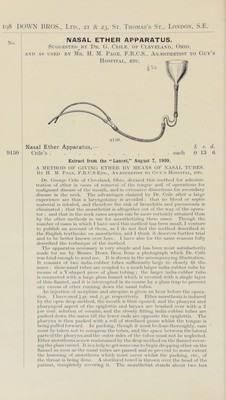
![Nasal Ether Apparatus, continue!,— bohiiul tho piitioiit. Tlio hroatliiiif? ainl tlio colour of tlio blood at the sito of the operation are watched and an occasional look at tho patient can he taken by raising the towel without interfering with theopei ator. It would he quite easy to give a little oxygen by passing a tube through tho tlannel, hut this has not been called for in the cases 1 luu’O anaesthetized. As to tho rate of dro[)ping the other, le.ss other was recjuired than in tho ordinary way of using tho open drop method. The first ca.so was one of extensive dissection of the neck for malignant disease secondary to that of the tongue. 'I'ho .second case wiis one of removal of half of tho tongue sid)se(iuent to the above operation. On this second occasion tho patient was aiucsthetized by .Mr. (Jeorgo Rowell. 1 was present oidy at tho beginning of tho oj)eration, but Mr. Kow('ll writes as follows : “ 'I’ho metliod answertal well. 'I'ho patient kept a good colour, while his breathing remained free and was unalTected by incoinenient refle.x action during all tho time that the tubes were in j)osition. N’ery little other was needed to maintain this ilegree of narcosis, ami at the end of the administration recoN'ory was raj)id.” In tho third case an extensive operation for clearing tho neck for secon- dary disc'ase was first done, and then half of tho tongue was r»‘mo\'ed at one sitting. Shortly after bc'ginning the dissection of tho neck it was noticed that tho blood was rather dark at the site of operation, and on raising tho towel some cyanosis of the face was found, so the mouth was opened, the gauze packing removed, and the pharynx repacked, after which the colour kept quite good for tho rest of the operation. One of the tubes may have been somewhat compressed. T'ho operation was not delayed for more than two minutes. As far as tho anicsthotist was concerned tho ciuses of removal of tho tongue pre.sented no difticulty and caused less anxiety than when tho tongue is removed under other methods of anresthesia, especially when a preliminary laryngotomy is not done. Tho patient in each case had recovered all tho refle.xes and spontaneous movement and was almost conscious when re- moved from tho operating table and coidd be sat u|) in bed immediately. I should say that this coiulition of tho patient is easier to eiisure after a long operation by this method than when chloroform has been given, d'ho third case, in which tho whole operation was done at one sitting, was naturally a long one and liable to be followed by a good deal of shock, but there was practically no shock at all. I do not thitd< tho method could be used when the whole of the tongue down to tho epiglottis is to be removed as there would not bo enough hold loft for tho packing. Mr. W. .Arbuthnot Lane and Mr. C. H. Fagge, who operated on these cases, have authorized mo to say that tho method gave a very free aceoss to tho sito of operation owing to tho amcsthetist being altogether out of the way, that anti.septic precautions were facilitated, that luemorrhage was not troid)lo- somo, anil that each patient made an uneventful recovery. I ha\'o used C'rile’s nasal tubes on two other occasions with chloroform instead of ether, t'hloroform had to be employi'd as fulgurafion was to be done after the ri'inova.l of the malignant disea.se from tho neck. .Morphia, and atropine were injected, aiursthesia was induced with chloroform, the |)hai\\nx was cocainized, and the nasal tube's weri' pa.ssed and tho pharynx packed as before. 'I'ho nasal tubi's were then coupled up with a Vernon Ilarcourt iidialer anil chloroform administered with a small quantity of oxygen. 'I’he ana'sthesia gave no trouble whatever on either occasion, the air-way and the working of the valves being more satisfactory than in some cases in which the N’ernon Harcourt inhaler is used with the face-jiiece. 'I'he patii'ut on each occasion kept a perfect colour, anil though each ad- ministration. owing to the fulguration, lasteil nearly two hours, move- ment and phonation had returned before the patient left the table. .\ faint corneal ri'flex was allowed to persist the whole time, but tho patient was absolutely still and there were no reflex effects on respiration or circu- lation. 'I'he strength of chloroform va]iour u.sed was in the first operation from my notes : “ .Most of the time ^ jier ci'iit., part of the time j |)er cent., never mori' than 1 per cent.” In the second administration ; “ 2 per cent, was usi'd at first for a short time, after which tho indicator varii'd between | pi'r cent, and 1 jii'r cent., bi'ing most of the time at ^ pi'r cent.” 'I'ho two operations wen' on tho same patient and there was a good deal of after-vomiting for twelve hours on each occiusion. 'I'his did not occur in the beforo-montionod cases jn which otlior was used.](https://iiif.wellcomecollection.org/image/b29012946_0207.jp2/full/800%2C/0/default.jpg)