Appendix to Down Bros.' catalogue of surgical instruments and appliances : Octoberr 1910 / Down Bros., Ltd.
- Down Bros. (Firm)
- Date:
- 1910
Licence: In copyright
Credit: Appendix to Down Bros.' catalogue of surgical instruments and appliances : Octoberr 1910 / Down Bros., Ltd. Source: Wellcome Collection.
96/264 (page 88)
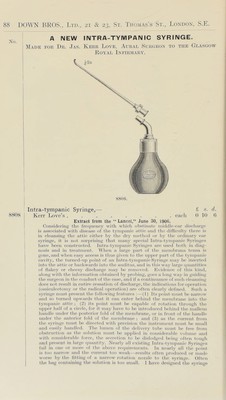
![No. 8808 A NEW INTRA-TYMPANIC SYRINGE. IMade for Dr. Jas. Kerr 1a)ve, Aural Surgeon to the Glasgow Royal Infirmary. Intra-tympanic Syringe,— £ s. d. Kerr Love’s ........ eaeli 0 10 6 Extract from the “ Lancet,” June 30, 1906. Considering the frequency with wliich obstinate middle-ear tlischarge is associated with disease of tlie tympanic attic and the difficulty there is in cleansing the attic either by the dry method or by the ordinary ear syringe, it is not surprising that many special Intra-tympa.nic Syringes have been constructed. lntra-tym]ianic Syringes are used both in diag- nosis and in treatment. When a large jiart of the membrana tensa is gone, and when easy access is thus given to the upjxw part of the tympanic cavity, the turned-up jioint of an I ntra-tymjianic Syringe may be inserted into the attic or backwards into the audit us, aud in this way large (|uantities of flakey or cheesy discharge may lx^ removed. FNidence of this kind, along with the information obtained by probing, gcx'S a long way in guiding Hie surgeon in tlie conduct of the case, and if a continuance of such cleansing does not result in entire cessation of discharge, the indications for operation (o.ssiculectomj? or the radical operation) are often clearly defined. Such a syringe must present the following features :—(1) Its ]X)int must Ix' narrow and so turned upwards that it can enter behind the membrane into the tympanic attic ; (2) its point must be capable of rotation through the upper half of a circle, for it may have to be introduced Ix'hind the malleus handle under the posterior fold of the memhrane, or in front of the handle under the anterior fold of the memlirane ; and (.3) as the current from the syringe Jiiust be directed with precision the instrument must be small and easily handled. 'I'he lumen of the delivery tube must be free from obstructii)!! as the solution must be apjdied iir considerable volume and with considerable force, the secretion to be dislodged being often tough and pre.sent in large quantity. Nearly all existing Intra-tympanic Syringes fail in one or more of the above recpiirements. In nearly all the point is too narrow and the current too weak—results often produced or made worse hy the fitting of a narrow rotation nozzle to the syringe. Often the bag containing the solution is too small. 1 have designed the syringe](https://iiif.wellcomecollection.org/image/b29012946_0096.jp2/full/800%2C/0/default.jpg)