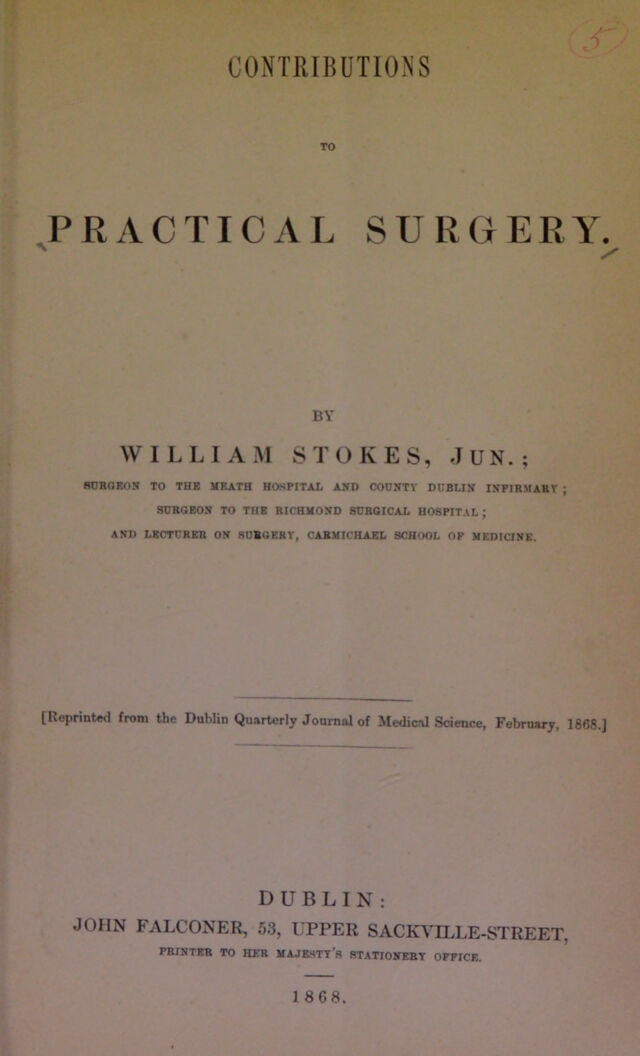
Contributions to practical surgery / by William Stokes, jun.
- Stokes, Sir William, 1839-1900.
- Date:
- 1868
Licence: Public Domain Mark
Credit: Contributions to practical surgery / by William Stokes, jun. Source: Wellcome Collection.
Provider: This material has been provided by The Royal College of Surgeons of England. The original may be consulted at The Royal College of Surgeons of England.
13/28 page 11
![In truth, the operation very seldom indeed terminates fatally, and when it does so, it is from pyemia or other causes, which are common to all operative procedures. The only instances which have fallen under my observation, and which terminated fatally, were two. One in which there was acute inflammatory disease in the joint at the time of the operation, and the other was one in which the operation was perfonued—I may add, not in this country, to our credit be it said—for no disease, but for a congeni- tal malformation of the elbow, wliich impeded, to a certain extent, the natural motions of the joint. In this latter case the patient died of pyemia on the eighth day after the operation. The particulars also of the case of C. Waddick, whose left elbow- joint I excised, and the account of which I published in the Dublin Quarterly Journal for May, 1865, fully bear out the truth of the statement made above in regard to not only the possibility but probability of obtaining subsequently ])crfect mobility in the new joint. The patient now enjoys every motion in the elbow that the healthy joint possesses, |>erfect power of flexion, extension, prona- tion, and supination. The osseous reformation also is very remarkable. Encouraged by the success attained in this case, and which I have seen in many cases equally well attained by other surgeons, I determined to give the jMitient, whose case I am about briefly to record, the chance of obtsiining, by similar means, the possession of a useful arm, and, as far as the case has gone, though in many respects an unfavourable one, owing to the large amount of disease which was found external to the joint, it promises to fulfil these not too sanguine expectations. Catherine Ryan, aged eight, a child of very delicate strumous tem- perament, was admitted under my care into the Meath Hospital, on the 24th of last dune. The right elbow, which was evidently the seat of very extensive scrofulous disease, had been affected for upwards of nine months, and had commenced, according to the accounts her parents gave, apparently without any local exciting cause. The joint was enormously enlarged, the result apparently not so much of any extensiv'e effusion as of great thickening and hypertrophy of the synovial and other soft structures. Though, in triith, in all such cases, when the disease is extensive, it is difficult, if not impossible, to define accurately what parts are chiefly affected. I he integuments, especially on the posterior aspect of the joint, were much disorganized, and in three or four phices had ulcerated,](https://iiif.wellcomecollection.org/image/b22329985_0015.jp2/full/800%2C/0/default.jpg)