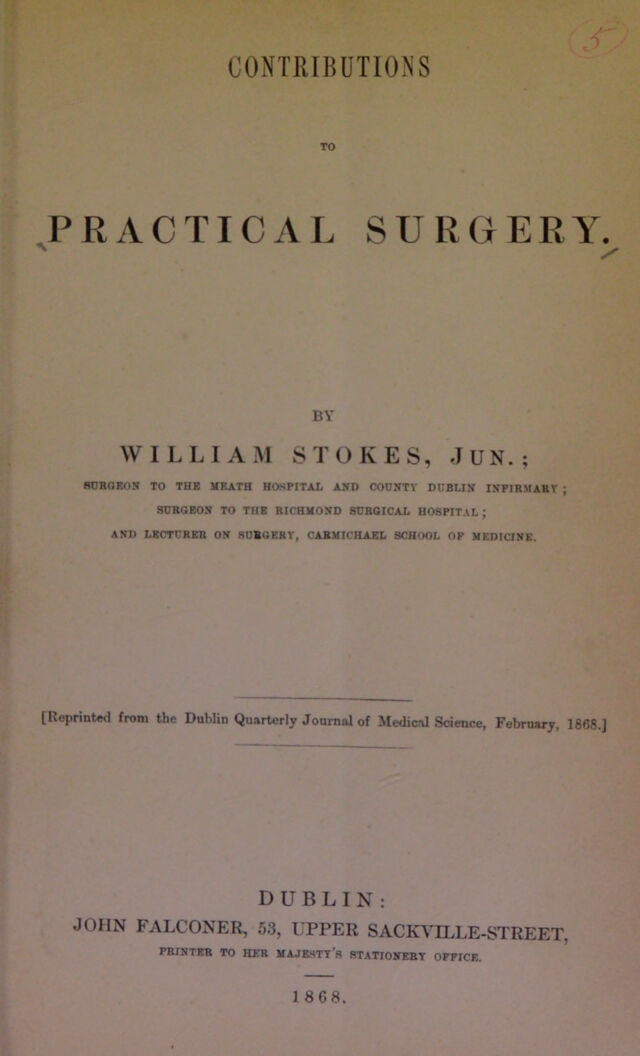
Contributions to practical surgery / by William Stokes, jun.
- Stokes, Sir William, 1839-1900.
- Date:
- 1868
Licence: Public Domain Mark
Credit: Contributions to practical surgery / by William Stokes, jun. Source: Wellcome Collection.
Provider: This material has been provided by The Royal College of Surgeons of England. The original may be consulted at The Royal College of Surgeons of England.
18/28 page 16
![most favoumble for convalescence and recovery—namely, between infancy and early adnlt life.” In gunshot wounds involving the knee-joint the results of excision liave been still more unfortunate. Of the seven cases recorded prior to the recent American war, only two terminated successfully, and of the eleven cases in which complete excision of the knee-joint was performed during the late protracted war, as recorded in Circular No. 6, a report of the surgical experiences acquired there, and recently published by the American Government, only two were successful, and in one of these the author of the report, Surgeon-General Dr. Barnes, states that the success was “ so extraordinary as to suggest some doubts as to its authenticity.” We should not forget, however how very difficult it must be during active military service to obtain the requisite hygienic and surgical resources necessary for the after treatment of such cases. Notwithstanding these unfavourable statistics, the operating surgeon can always derive encouragement from the records of the cases, collected from various sources by ]\Ir. Butcher, for he Avill find that of the ninety-nine cases in these tables only tAventy-five deaths are recorded, and of the remainder, tAventy-four Avere “ under treatment,” and said to be recovering, and forty-tAvo Avere “ cured.” In truth, one chief cause for the ill-success Avhich now so often attends this operation is, I think, that surgeons have too often looked upon the procedure as an alternative for amputation, and very rarely, indeed, as one of expediency. In other Avords, it is too often deferred until even the propriety of amputation might properly be questioned. The particulars connected Avith this case I am about very briefly to record, have suggested these preliminary remarks; for I cannot but think it more than probable, that had the operation been performed at an earlier period, Avhen the vital poAvers of the patient Avere not brought to so Ioav an ebb, the chances of bringing the case to a successful termination Avould have been largely increased. Susan Ilillas, aged tAventy-threc, was admitted into the Meath Hospital in last February, having been recommended to me by my friend and colleague in the Carmichael School, Dr. R. ShaAv. Her condition on admission into hospital Avas truly pitiable. There Avas great emaciation, an expression of long-continued suffering, and much prostration from a continuance of sleepless nights, produced by the often repeated and violent starting pains, so characteristic of](https://iiif.wellcomecollection.org/image/b22329985_0020.jp2/full/800%2C/0/default.jpg)