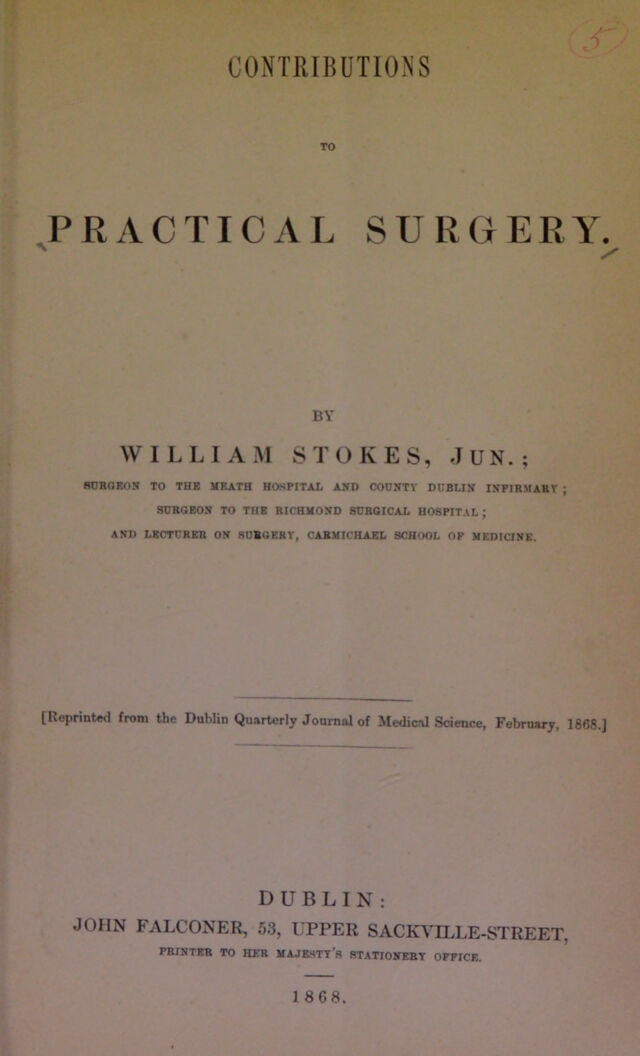
Contributions to practical surgery / by William Stokes, jun.
- Stokes, Sir William, 1839-1900.
- Date:
- 1868
Licence: Public Domain Mark
Credit: Contributions to practical surgery / by William Stokes, jun. Source: Wellcome Collection.
Provider: This material has been provided by The Royal College of Surgeons of England. The original may be consulted at The Royal College of Surgeons of England.
7/28 page 5
![extracted of the inferior extremities of both fibula and tibia, as well as some portions of the astragalus. The wound w’as then dressed, the foot being supported by a suitable apparatus, which was not removed for four days. No accident occurred during the patient’s convalescence, which lasted about four months. \V hen he left the hospital of Valenciennes to go to the Invalides, he w’as able to walk without any support. There was no re-formation of the portion of the fibula which had been removed.” The next case occurred in the practice of the elder Moreau, in 1792. The case was one of extensive caries of the left ankle, which was induced by a severe sprain the patient received about a year before coming under the care of ]\I. INloreau. “ Ihere was a fistu- lous ulcer on each side of the joint, from which a sanious and fetid pus was discharged; and the probe being introduced through the openings, the articulating surface of the tibia, as well as that of the fibula, and the body of the astragalus, were felt to be bare. The foot and lower j)art of the leg were swelled. There w'as a dull pain in the dieased part, and the patient could not lean his weight on the limb.”* As there is apparently great confusion and probable in- accuracy in the description of the operation, we shall not enter mto any discussion as regards the procedure. The result, however, of this operation we may state; the |)atient was not “ able to lean his weight upon the foot till the sixth month after the operation. During the seventh he used crutches. In the eighth month he could walk with a stick, and by the end of the ninth month he walked without any assistance Avhatever, and in such a way that he could do what he pleased !” It is to be regretted that although the result of the case is described as being “ surprising,” no mention is made as to whether any sinus or other evidence of existing disease remained after the operation. As a detailed account of the cases of greatest interest in which the operation of excision of the ankle-joint has been performed since the time of the Moreaus, has been given by Professor Hancock in his deeply interesting and valuable Lectures on the Surgery of the Human Foot, delivered at the Royal College of Surgeons of England in last June, it is unnecessary for me, on the present occasion, to give a renewed account of them. As far as 1 cun determine, it appears that the operation has been performed fifty-one times, and of these thirty-eight have been successful, and thirteen unsuccessful, which gives about seventy-five per cent, of * Cases of Excision of Carious Joints. By P. J. Moreau. Trans, by J. Jeffrey, M.D., Glasgow, 1806.](https://iiif.wellcomecollection.org/image/b22329985_0009.jp2/full/800%2C/0/default.jpg)