Dr. Gregory's conspectus medicinae theoreticae : embracing pathology and physiology / with the original text, an ordo verborum, and literal translation. By John Steggall.
- James Gregory
- Date:
- 1855
Licence: Public Domain Mark
Credit: Dr. Gregory's conspectus medicinae theoreticae : embracing pathology and physiology / with the original text, an ordo verborum, and literal translation. By John Steggall. Source: Wellcome Collection.
Provider: This material has been provided by Royal College of Physicians, London. The original may be consulted at Royal College of Physicians, London.
85/580 page 77
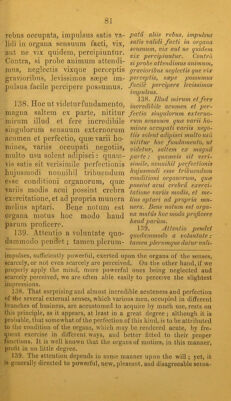
![efScitur) ad animuni solum spec- tat, et liiiic propria est, sua oatura fugax et peritura, et simul simpli- cissima, nullisque aut defiuienda aut describenda verbis, rei externee quse sensum excitat disfeimillima, ab omui corporea conditione atque natura alienissima, ita ut neque ipsa, nec quicquam ipsi simile, in re externa quam percipimus iuesse possit. 131. Altera vero res quse vulgo subnomiuesensuscomprelieuditur, qualitas nimirum quse vis rei ex- ternse quam coutemplamur, qtiara seusus (mutatio scilicet in animi statu) nobis representat vel sug- gerit, longe diversse videtur esse naturae. Qualitates enim rerum externarura, quas sensus ope per- cipimus, ad illas res solas pertinent; neque anirao ullo pacto inesse pos- suut, nec quicquam cum animo, variisque ejus statibus, simile aut ficitur in statu animi) spec- tat ad anirnum solum, et est propria hide, fugax et peritura sud natura, et simul simplicissima, que aut definienda aut descri- benda nullis verbis, dissimil- Uma rei externce quee ex- citat sensum, alienissima ab Omni corporea conditione at- que natura, ita ut neque ipsa, nec qidcqtiam simile ipsi, possit inesse in externa re, quam percipimus. 131. Verb altera res quee vulgo comprehenditur sub nomine sensus nimirum quae- vis qualitas externce rei quam coutemplamur, quam sensus (scilicet mutatio in statu animi) representat vet suggerit nobis videtur esse longe diversce naturae. Enim qualitates externarum re- rum, quas percipimus ope sensus, pertinent ad illas res solas; neque possunt inesse animo ullo paclo, nec habent qidcquam simile aut commune cum animo state of the minr],) refers to the mind only, and is peculiar to this, fleeting and perishable in its nature, and at the same time most simple, and to be either defined or described by no terms, most unlike the ex- ternal object which excites sensation, very different from every cor- poreal state and nature, so that neither itself, nor anything like it, can exist in the external ol)ject, w'hich w'e perceive. 131. But the other thing which is commonly comprehended under the name of sensation, that is, any quality of an external object which we contemplate, w'hich the sensation (namely, the change in the state of mind,) represents or suggests to ns, appears to be of a very different nature. For the qualities of external things, which we perceive by the aid of sensation, relate to those thitigs alone, nor can exist in the mind in any degree, nor have thev anv thing alike or in common with the 7 §](https://iiif.wellcomecollection.org/image/b28149452_0085.jp2/full/800%2C/0/default.jpg)