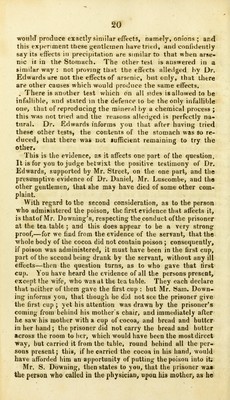
Trial of Robert Sawle Donnall, on suspicion of poisoning Mrs. Downing, his mother in law, tried at Launceston, March 31, 1817, at the Lent Assize, for the county of Cornwall, before the Hon. Sir Charles Abbott, Knt.
- Donnall, Robert Sawle
- Date:
- [1817]
Licence: Public Domain Mark
Credit: Trial of Robert Sawle Donnall, on suspicion of poisoning Mrs. Downing, his mother in law, tried at Launceston, March 31, 1817, at the Lent Assize, for the county of Cornwall, before the Hon. Sir Charles Abbott, Knt. Source: Wellcome Collection.
20/30 page 16
![ces as described by Dr. Edwards. Witness had heard of the administration of medicine to Mrs. Downing, by the prisoner, and considered the treatment as partly right, and partly •wrong ; right with respect to the opium, and wrong as to the emetic, which could only cause an increase of irritation. Dr. E/s prescription was shewn to Mr. Tucker, and his o- pinion aked on it. It being of a purgative, and consequently, debilitating nature, he said it was adding weight to a por- ter's back. [Here the Judge interfered by remarking that snch metaphorical expressions might lessen the reputation of Dr. Edwards.—Witness replied, My Lord, I do not forget fceing a much younger man in the profession, or his high and merited reputation ; but my opinions affect the prisoner, as much as they do Dr. Edwards.] Witness should have given opium in large portions. He had opened the bodies of men dying by accidents, and it may lead any person unaccustomed to it, to form an erroneous opinion respecting the vascular appearance of the sto- mach. He found that inflammation on the stomach so as to produce death, would thicken it rather than otherwise; his opinion of Dr. Edwards' tests, was, that they were not infal- lible, as many other substances would produce the same re- sult as arsenic. Phosphoric acid abounds in the human frame, and may produce the same effects in the stomach. Witness has known the prisoner for many years, and his character was always what it ought to be, kind, humane and tender. , i Mr. Tucker, has again and again tried the first and second experi- ments, with regard to the first, he says, that some years ago, Dr. Marcet, a Physician, in London, recommended it to the public, and then considered it a most delicate test for arsenic, since, however, the same physician had publicly acknowledged his error, it having been pointed out to him by one of his pupils, who observed, that if any phosphoric acid exists in the stomach the same yellow precipitate will be thrown dowtf. Now it is well known that most of the animal fluids abound with phosphoric acid, suspects this might have deceived Dr. Edwards. With regard to the second test, it was his decided opinion to be fallible, and from this circumstance, that as Mrs. Downing eat the day she was taken ill some boiled onions and rabbit, it induced him to make an experiment, he did so by infusing with the onions some animal matter, this was filtred off, and to it was added, a solution of sulphate of copper, the immediate consequence was a green precipitate exactly resembling that thrown down by arsenic. He further observes that he considers all tests fallible excepting that of evaporating the sus- pected fluid to dryness, and sublimating the residuum in a closed piece of glass tube, if in this arsenic be present, it will be seen in its metal- lic state. Dr. Cookworthy, of Plymouth. Had heard the examina-](https://iiif.wellcomecollection.org/image/b20443559_0020.jp2/full/800%2C/0/default.jpg)