A translation of the pharmacopoeia of the Royal College of Physicians of London, 1836. With notes and illustrations / By Richard Phillips.
- Royal College of Physicians, London
- Date:
- 1837
Licence: Public Domain Mark
Credit: A translation of the pharmacopoeia of the Royal College of Physicians of London, 1836. With notes and illustrations / By Richard Phillips. Source: Wellcome Collection.
106/454 page 78
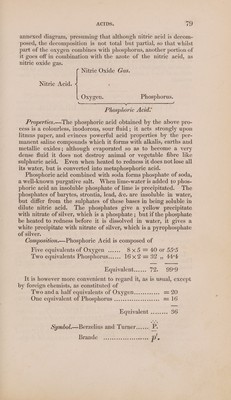
![water in a glass retort placed in a sand-bath; then apply heat, until eight fluidounces are produced [distilled]. Put these again into the retort that eight fluidounces may distil, which are to be rejected. Evaporate the re- maining liquor in a capsule made of platina until only two ounces and six drachms remain. Lastly, add to the Acid, when it is cold, as much distilled water as may be sufficient to make it accurately measure twenty eight fluidounces. ee ee Remarks.—Phosphorus is a well-known elementary body, which combines readily with oxygen to form one oxide and several acids ; of these the best known and most important is the phos- phoric acid, and it is formed when phosphorus is burnt in oxygen gas, oratmospheric air; when united with bases it constitutes some of the salts of the animal fluids, and combined with lime it forms phosphate of lime, almost the whole of the harder portion of bone. Phosphorus is procured from the phosphoric acid of burnt bones, by treating them with dilute sulphuric acid, which combining with the greater part of the lime separates the phosphoric acid, and this by evaporation and subsequent treatment with char- coal in a retort at a high temperature, loses its oxygen, and the phosphorus being vaporized is condensed in water. Phosphorus is solid, translucent and nearly colourless; it is so soft that it may be indented by the nail and very easily cut. It fuses at about 108°, and at 550° it is vaporized ; it is insoluble in water or alcohol, but dissolved by ether and by oils. It is ex- tremely inflammable, and has been known to take fire in the air spontaneously when its temperature was not above 60°. On this account it is always kept in water ; it undergoes slow combustion when exposed to the air, and hence is luminous in the dark, and it emits a disagreeable garlic-like smell. Process.—Nitric acid, as has been already explained, is a com- pound of oxygen and azote, which, when exposed to, and espe- cially if heated with, certain bodies that have a powerful affinity for oxygen, it is decomposed by them. This is particularly the case with phosphorus, which if added to strong nitric acid decom- poses it with explosion and rapid combustion. When diluted nitric acid is used, as here directed, the action is slow, the phos- phorus gradually melts, separates the acid into oxygen, with which it combines, and nitric oxide gas, which is evolved. A portion of the nitric acid distils before the whole of the phosphorus is aci- dified, and hence the necessity of returning it into the retort as ordered. ‘The reaction which occurs will be understood by the](https://iiif.wellcomecollection.org/image/b2934072x_0106.jp2/full/800%2C/0/default.jpg)
 No text description is available for this image
 No text description is available for this image
 No text description is available for this image