A translation of the pharmacopoeia of the Royal College of Physicians of London, 1836. With notes and illustrations / By Richard Phillips.
- Royal College of Physicians, London
- Date:
- 1837
Licence: Public Domain Mark
Credit: A translation of the pharmacopoeia of the Royal College of Physicians of London, 1836. With notes and illustrations / By Richard Phillips. Source: Wellcome Collection.
88/454 page 60
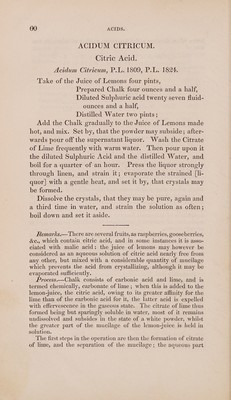
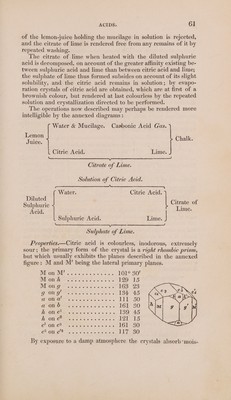
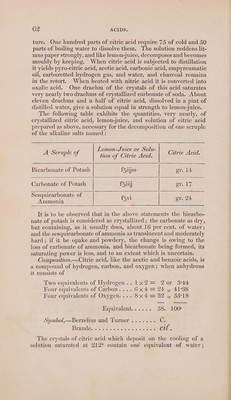
![ACIDUM CITRICUM. Citric Acid. Acidum Citricum, P.L. 1809, P.L. 1824. Take of the Juice of Lemons four pints, Prepared Chalk four ounces and a half, Diluted Sulphuric acid twenty seven fluid- ounces and a half, Distilled Water two pints; Add the Chalk gradually to the Juice of Lemons made hot, and mix. Set by, that the powder may subside; after- wards pour off the supernatant liquor. Wash the Citrate of Lime frequently with warm water. ‘Then pour upon it the diluted Sulphuric Acid and the distilled Water, and boil for a quarter of an hour. Press the liquor strongly through linen, and strain it; evaporate the strained ([li- quor] with a gentle heat, and set it by, that crystals may be formed. Dissolve the crystals, that they may be pure, again and a third time in water, and strain the solution as often; boil down and set it aside. Remarks.—There are several fruits, as raspberries, gooseberries, &ec., which contain citric acid, and in some instances it is asso- ciated with malic acid: the juice of lemons may however be considered as an aqueous solution of citric acid nearly free from any other, but mixed with a considerable quantity of mucilage which prevents the acid from crystallizing, although it may be evaporated sufficiently. Process.—Chalk consists of carbonic acid and lime, and is termed chemically, carbonate of lime; when this is added to the lemon-juice, the citric acid, owing to its greater affinity for the lime than of the carbonic acid for it, the latter acid is expelled with effervescence in the gaseous state. The citrate of lime thus formed being but sparingly soluble in water, most of it remains undissolved and subsides in the state of a white powder, whilst the greater part of the mucilage of the lemon-juice is held in solution. The first steps in the operation are then the formation of citrate of lime, and the separation of the mucilage ; the aqueous part](https://iiif.wellcomecollection.org/image/b2934072x_0088.jp2/full/800%2C/0/default.jpg)
 No text description is available for this image
 No text description is available for this image
 No text description is available for this image