Experiments to ascertain if antelope may act as a reservoir of the virus of sleeping sickness (Trypanosoma gambiense) / by Sir David Bruce, A.E. Hamerton and H.R. Bateman.
- David Bruce
- Date:
- 1911]
Licence: Public Domain Mark
Credit: Experiments to ascertain if antelope may act as a reservoir of the virus of sleeping sickness (Trypanosoma gambiense) / by Sir David Bruce, A.E. Hamerton and H.R. Bateman. Source: Wellcome Collection.
6/22 page 314
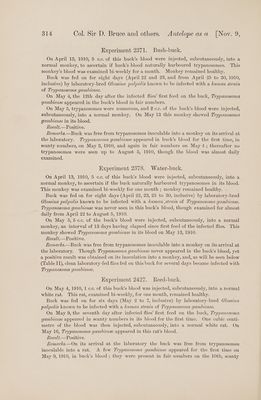
![Experiment 2371. Bush-buck. On April 18, 1910, 5 ec. of this buck’s blood were injected, subcutaneously, into a normal monkey, to ascertain if buck’s blood naturally harboured trypanosomes. This monkey’s blood was examined bi-weekly for a month. Monkey remained healthy. Buck was fed on for eight days (April 22 and 23, and from April 25 to 30, 1910, inclusive) by laboratory-bred Glossina palpalis known to be infected with a human strain of Trypanosoma gambiense. ' On May 4, the 12th day after the infected flies’ first feed on the buck, 7rypanosoma gambiense appeared in the buck’s blood in fair numbers. On May 5, trypanosomes were numerous, and 2 ¢.c. of the buck’s blood were injected, subcutaneously, into a normal monkey. On May 13 this monkey showed Trypanosoma gambiense in its blood. Result.— Positive. Remarks.—Buck was free from trypanosomes inoculable into a monkey on its arrival at the laboratory. Trypanosoma gambiense appeared in buck’s blood for the first time, in scanty numbers, on May 3, 1910, and again in fair numbers on May 4; thereafter no trypanosomes were seen up to August 5, 1910, though the blood was almost daily examined. Experiment 2378. Water-buck. On April 13, 1910, 5 c.c. of this buck’s blood were injected, subcutaneously, into a normal monkey, to ascertain if the buck naturally harboured trypanosomes in its blood. This monkey was examined bi-weekly for one month ; monkey remained healthy. Buck was fed on for eight days (April 22, 23, 25 to 30, inclusive) by laboratory-bred Glossina palpalis known to be infected with a human_strain of Trypanosoma gambiense. Trypanosoma gambiense was never seen in this buck’s blood, though examined for almost daily from April 22 to August 5, 1910. On May 5, 5.c.c. of the buck’s blood were injected, subcutaneously, into a normal monkey, an interval of 13 days having elapsed since first feed of the infected flies. This monkey showed Trypanosoma gambiense in its blood on May 13, 1910. Result.— Positive. Remarks.—Buck was free from trypanosomes inoculable into a monkey on its arrival at the laboratory. Though Trypanosoma gambiense never appeared in the buck’s blood, yet a positive result was obtained on its inoculation into a monkey, and, as will be seen below (Table IL), clean laboratory-fed flies fed on this buck for several days became infected with Trypanosoma gambiense. Experiment 2427. Reed-buck. On May 4, 1910, 1 ¢.c. of this buck’s blood was injected, subcutaneously, into a norma] white rat. This rat, examined bi-weekly, for one month, remained healthy. Buck was fed on for six days (May 2 to 7, inclusive) by laboratory-bred Glossina palpalis known to be infected with a human strain of Trypanosoma gambiense. On May 9, the seventh day after infected flies’ first feed on the buck, 7rypanosoma gambiense appeared in scanty numbers in its blood for the first time. One cubic centi- metre of the blood was then injected, subcutaneously, into a normal white rat. On May 16, Trypanosoma gumbiense appeared in this rat’s blood. Result.—Positive. Remarks.—On its arrival at the laboratory the buck was free from trypanosomes inoculable into a rat. A few Trypanosoma gambiense appeared for the first time on May 9, 1910, in buck’s blood ; they were present in fair numbers on the 10th, scanty](https://iiif.wellcomecollection.org/image/b33432843_0006.jp2/full/800%2C/0/default.jpg)