Demonstrations of anatomy : being a guide to the dissection of the human body / by G.V. Ellis.
- George Viner Ellis
- Date:
- 1887
Licence: Public Domain Mark
Credit: Demonstrations of anatomy : being a guide to the dissection of the human body / by G.V. Ellis. Source: Wellcome Collection.
Provider: This material has been provided by The University of Leeds Library. The original may be consulted at The University of Leeds Library.
186/790 (page 172)
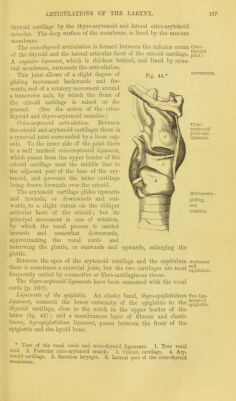
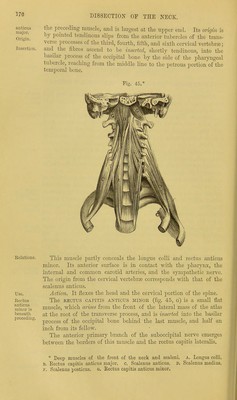
![Relation to the uerves. A vein, and nerves are with it. Brandies. Vertebral vein. Origin. Course. Ending. Branches. Vertebra] plexus of nerves. its course upwards the artery lies in front of the anterior trunks of the cervical nerves, except the first, which crosses on the inner side. The vessel is accompanied by a vein, and by a plexus of nerves of the same name. In the neck the artery furnishes small twigs to the surrounding muscles, the spinal canal, and the spinal cord. The vertebral vein begins on the neural arch of the alias by tin- union of a considerable offset from the intraspinal venous plexuses with other branches proceeding from a network between the muscles in the suboccipital region. It is also joined by the emissary vein leaving the skull through the posterior condylar foramen when that aperture is present. Accompanying its artery in the neck, the vein descends through the foramina in the transverse processes of the cervical vertebra?, and terminates by emptying itself into the innominate trunk. In this course it is joined by branches from the internal and external spinal veins ; its other tributaries are noticed at p. 70. The vertebral plexus of nerves is derived from the inferior cervical ganglion of the sympathetic (p. ] 15). It surrounds the artery, and communicates with the spinal nerves which it crosses. Section XIX. LIGAMENTS OF THE VEETEBEiE AND CLAVICLE. Directions. Directions. On the remaining part of the spine, the ligaments connecting the cervical vertebrae to each other and to the occipital bone are to be learnt. Dissection. Dissection. Disarticulate the last cervical from the first dorsal vertebra. Then remove altogether the muscles, vessels, nerves, and areolar tissue and fat from the cervical vertebras. By sawing through the occipital bone, so as to leave only an osseous ring behind the foramen magnum, the ligaments between the atlas and the occipital bone can be more easily cleaned. Common The common ligaments attaching together the cervical vertebra; vertebra8 °f are shnilar to those uniting the vertebra? in other parts of the spine, viz., an anterior and a posterior common ligament, bands between the lamina? and spines, capsular ligaments lined by synovial mem- brane for the articular processes, and an intervertebral disc between the bodies of the bones. are Directions. The common ligaments will be best seen on the dorsal dse^viiere or llunDar portion of the spine, where they are more strongly developed ; their preparation and description will be found at the end of the thorax, with the description of the ligaments of the spine (p. 374). Should the student examine them in the neck to see their difference in this region, he should leave uncut the neural](https://iiif.wellcomecollection.org/image/b21518439_0186.jp2/full/800%2C/0/default.jpg)