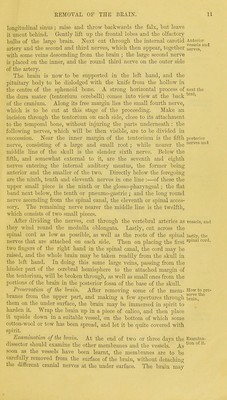
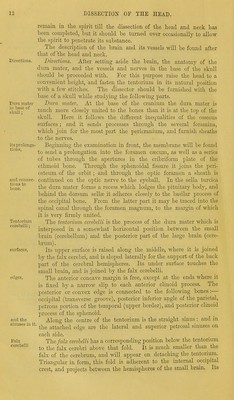
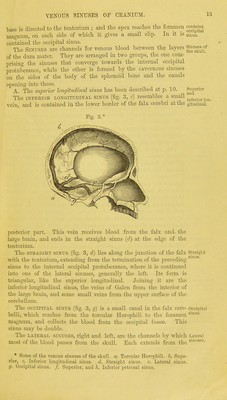
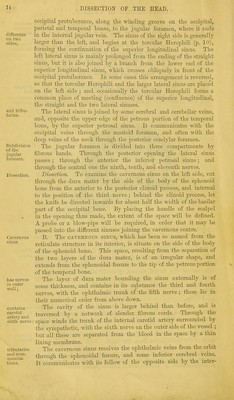
Demonstrations of anatomy : being a guide to the dissection of the human body / by G.V. Ellis.
- George Viner Ellis
- Date:
- 1887
Licence: Public Domain Mark
Credit: Demonstrations of anatomy : being a guide to the dissection of the human body / by G.V. Ellis. Source: Wellcome Collection.
Provider: This material has been provided by The University of Leeds Library. The original may be consulted at The University of Leeds Library.
46/790 (page 32)
![ligament is thin and loose, but at the outer part it is somewhat thicker and stronger. A fibrous The fibrous plates (tarsi), one for each eyelid, are elongated piartCof°theS transversely, and give strength to the lids. Each is fixed internally fid: and externally by fibrous bands—the tarsal ligaments, to the margin of the orbit. The border corresponding with the edge of the lid is free, and thicker than the rest of the plate. On the deep surface each tarsus is lined by the mucous membrane or conjunctiva, difference in The tarsi are not alike in the two lids. In the upper eyelid, ie wo i s. wkere t]ie f[Drous plate is larger, it is crescentic in shape, and is nearly half an inch wide in the centre; and to its fore part the tendon of the levator palpebrae is attached. In the lower lid the tarsus is a narrow band, about two lines broad, with nearly straight borders. Ligaments The internal tarsal ligament (tendo palpebrarum) is a small fibrous attach tarsi, band at the inner side of the orbit, which serves to fix the lids, and is attached to the anterior margin of the lachrymal groove in the upper jaw. It is about a quarter of an inch long, and divides into two processes, which are united with the tarsal plates, one to each. This ligament crosses the lachrymal sac, behind which it sends a fibrous expansion ; and the fleshy fibres of the orbicularis palpebrarum arise from it. The external tarsal ligament is a much weaker band uniting the tarsi to the malar bone. Sebaceous ^ The Meibomian or tarsal glands are embedded in the substance of ' the tarsal plates, and can be readily seen through the conjunctiva on the posterior surface of the lids. They extend, parallel to one another, from the free towards the opposite margin of the tarsus; and their number is about thirty in the upper, and twenty in the lower lid. The apertures of the glands open in a line at the free border of the lid near the posterior edge. their Each gland is a small yellowish tube, closed at one end, and structure, haying minute lateral caecal appendages connected with it. The secretion is similar to that of the sebaceous glands of the skin. Tendon of If the palpebral ligament be cut through in the upper lid, the levator tendon of the levator 'palpebral will be seen to be inserted into the palpebral. r 1 fore part of the tarsus by a wide aponeurotic expansion. Mucous The conjunctiva, or mucous membrane, lines the interior of the lining of lid. from wrijc}j ft js reflected to the front of the eyeball. The line of reflection is known as the fornix conjunctiva;, and is placed, above and below, some distance beyond the convex margin of the tarsus. Inside the lids the conjunctiva is inseparably united to the tarsi, and has numerous fine papillae. At the free margin of the lids it joins the skin, and through the lachrymal canals and nasal duct it is continuous with the pituitary membrane of the nose. Caruncle Between the eyeball and the inner commissure of the lids is seen a prominent and fleshy-looking body—caruncula lachrymalis (fig. 13, 4), which contains a group of glands, and has a few minute hairs and con- on its surface. External to the caruncle is a small vertical fold of tiguousfoid. tjje muc0us membrane—plica semilunaris, resting on the inner part of the eyeball.](https://iiif.wellcomecollection.org/image/b21518439_0046.jp2/full/800%2C/0/default.jpg)