Report on the outbreak of the plague at Sydney, 1900 / by the Chief Medical Officer of the Government and President of the Board of Health.
- Thompson, J. Ashburton (John Ashburton), 1848-1915.
- Date:
- 1900
Licence: In copyright
Credit: Report on the outbreak of the plague at Sydney, 1900 / by the Chief Medical Officer of the Government and President of the Board of Health. Source: Wellcome Collection.
Provider: This material has been provided by King’s College London. The original may be consulted at King’s College London.
28/112 page 22
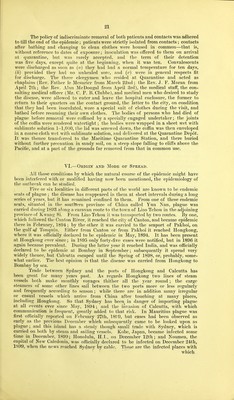
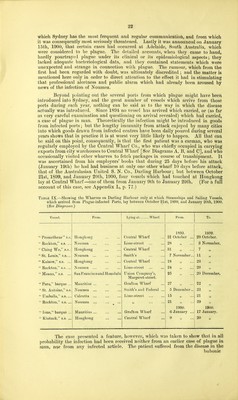
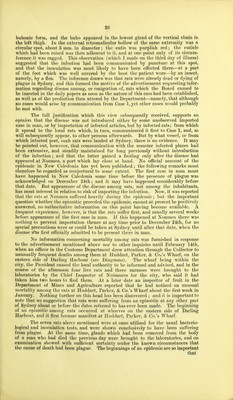
![which Sydney has the most frequent and regular communication, and from which it was consequently most seriously threatened. Lastly it was announced on January 15th, 1900, that certain cases had occurred at Adelaide, South Australia, which were considered to be plague. The detailed accounts, when they came to hand, hardly pourtrayed plague under its clinical or its epidemiological aspects; they lacked adequate bacteriological data, and they contained statements which were unexpected and strange in connection with plague. The rumour, which from the first had been regarded with doubt, was ultimately discredited ; and the matter is mentioned here only in order to direct attention to the effect it had in stimulating that jjrofessional alertness and public alarm which had already been aroused by news of the infection of Noumea. Beyond pointing out the several ports from which plague might have been introduced into Sydney, and the great number of vessels which arrive from those ports during each year, nothing can be said as to the way in which the disease actually was introduced. Since 1894 no vessel has arrived which carried, or (as far as very careful examination and questioning on arrival revealed) which had carried, a case of plague in man. Theoretically the infection might be introduced in goods from infected ports; but the lengthy immunity from attack enjoyed by many cities into which goods drawn from infected centres have been daily poured during several years shows that in practice it is at worst very little likely to happen. All that can be said on this point, consequently, is that the first patient was a carman, who was regularly employed by the Central Wharf Co., who was chiefly occupied in carrying exports from city warehouses to Central Wharf [See Diagrams A, B, and C], and who occasionally visited other wharves to fetch packages in course of transhipment. It was ascertained from his employers' books that during 25 days before his attack (January 19th) lie had had business at only one other wharf 10 days before attack, that of the Australasian United S, N. Co., Darling Harbour; but between October 21st, 1899, and January 20th, 1900, four vessels which had touched at Hongkong lay at Central Wharf—one of them from January 9th to January 20tli. (For a full account of this case, see Appendix L, p. 77.) Table IX.—Showing the Wharves on Darling Harbour only at which Steamships and Sailing Vessels, which arrived from Plague-infected Ports, lay between October 21st, 1899, aud January 20th, 1900. ((See Diagrams.) Vessel. From. From. To. Prometheus s.s. Hongkong Central Wharf 1899. 21 October ... 1899. 29 October. Rockton,'' s.s. ... Noumea ... Lime-street 28 3 November. Ching Wo, s.s.. Hongkong Central Wharf 31 7 „ St. Louis, S.S.... Noumea Smith's 7 November... 11 „ Kaisow, s.s. ... Hongkong Central Wharf 18 23 Eockton, s.s. ... Noumea ... Lime-street 24 „ ... 29 Moana, s.s. ... SanErancisco and Honolulu Union Company's, Margaret-street. 25 „ ... 20 December. Peru, barque ... M^auritius'... Grafton Wharf 27 „ ... 22 „ St. Autoine, s.s. Noumea ... Smith's and Federal ... 5 December... 23 „ Umballa, s.s. ... Calcutta ... Lime-street 15 „ 21 „ Eockton, s.s. ... Noumea ... • >) 21 „ 29 „ lone, barque ... Mauritius ... Grafton Wharf 1900. 6 January ... 1900. 17 January. Kintuck, s.s. ... Hongkong Central Wharf 9 » ... 20 „ The case presented a feature, however, which was taken to show that in all probability the infection had been received neither from an earlier case of plague in man, nor from any infected article. The patient suffered from the disease in the bubonic](https://iiif.wellcomecollection.org/image/b21298968_0028.jp2/full/800%2C/0/default.jpg)


 No text description is available for this image
 No text description is available for this image
 No text description is available for this image