Report on the outbreak of the plague at Sydney, 1900 / by the Chief Medical Officer of the Government and President of the Board of Health.
- Thompson, J. Ashburton (John Ashburton), 1848-1915.
- Date:
- 1900
Licence: In copyright
Credit: Report on the outbreak of the plague at Sydney, 1900 / by the Chief Medical Officer of the Government and President of the Board of Health. Source: Wellcome Collection.
Provider: This material has been provided by King’s College London. The original may be consulted at King’s College London.
8/112 page 2
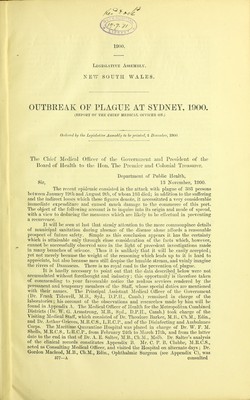
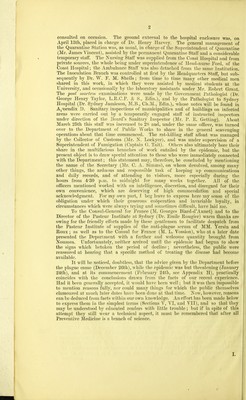
![consulted on occasion. The ground external to the hospital enclosure was, on April 13th, placed in charge of Dr. Hemy Harvey. The general management of the Quarantine Station was, as usual, in charge of the Superintendent of Quarantine (Mr. James Vincent), assisted by the permanent Quarantine Staff and a considerable temporary staff. The Nursing Staff was supplied from the Coast Hospital and from private sources, the wdiole being under superintendence of Head-nurse Ford, of the Coast Hospital; the Ambulance Staff was also detached from the same Institution. The Inoculation Branch was controlled at first by the Headquarters Staff, but sub- sequently by Dr. W. P. M. Shells; from time to time many other medical men shared in this work, in which they were assisted by medical students at the University, and occasionally by the laboratory assistants under Mr. Hobert Grant. The post mortem examinations were made by the Government Pathologist (Dr. George Henry Taylor, L.E.C.P. & S., Edin.), and by the Pathologist to Sydney Hospital (Dr. Sydney Jamieson, M.B., Ch.M., Edin.), whose notes will be found in A^>T)endix D. Sanitary inspections of municipalities and of buildings on infected areas were carried out by a temporarily engaged staff of instructed inspectors under direction of the Board's Sanitary Inspector (Mr. P. E. Getting). About March 25th this staff was increased to 28 and, under the same officer, was turned over to the Department of Public Works to share in the general scavenging operations about that time commenced. The rat-killing staff afloat was managed by the Collector of Customs (Mr. N. Lockyer), and was under supervision of a Superintendent of Eumigation (Captain G. Tait). Others also ultimately bore their share in the multifarious branches of work eutailed by the epidemic, but the present object is to draw special attention to those who were immediately connected with the Department; this statement may, therefore, be concluded by mentioning the name oi: the Secretary (Mr. C. A. Simms), on whom devolved, among many other things, the arduous and responsible task of keeping uj) communications and daily records, and of attending to visitors, more especially during the hours from -I'SO p.m. to midnight for many weeks together. All of the officers mentioned worked with an intelligence, discretion, and disregard for their own convenience, which are deserving of high commendation and special acknowledgment. Eor my own part, I beg leave to express here my sense of the obligation under which their generous cooperation and invariable loyalty, in circumstances which Avere always trying and sometimes difficult, have laid me. To the Consul-General for Erance (M. Georges Biard-d'Aunet) and to the Director of the Pasteur Institute at Sydney (Dr. Emile Bougier) warm thanks are owing for the friendly efforts made by these gentlemen to facilitate despatch from the Pasteur Institute of supplies of tbe anti-plague serum of MM. Yersin and Boux ; as well as to the Consul for Erance (M. L. Vossion), who at a later date presented the Department with a farther and welcome quantity brought from Noumea. Unfortunately, neither arrived until the epidemic had begun to show the signs which betoken the period of decline; nevertheless, the public were reassured at hearing that a specific method of treating the disease had become available. It will be noticed, doul^tless, that the advice given by tlie Department before the ])lague came (December 26th), while the epidemic was but threatening (January 24th), and at its commencement (Ecbruary 24th, see Appendix H), practically coincides with the conclusions drawn from the facts of our recent experience. Had it been generally accepted, it would have been well; but it wa^ then impossible to mention reasons fully, nor could many things for which the public themselves clamoured at much later dates have been done at that time. Now, however, reasons can be deduced from facts within our own knowledge. An effort lias been made below to express them in the simplest terms (Sections V, YI, and YII), and so that they may be understood by educated readers witli little trouble ; but if in spite of this attempt they still wear a technical aspect, it must be remembered that after all Preventive Medicine is a branch of science. I.](https://iiif.wellcomecollection.org/image/b21298968_0008.jp2/full/800%2C/0/default.jpg)


 No text description is available for this image
 No text description is available for this image
 No text description is available for this image