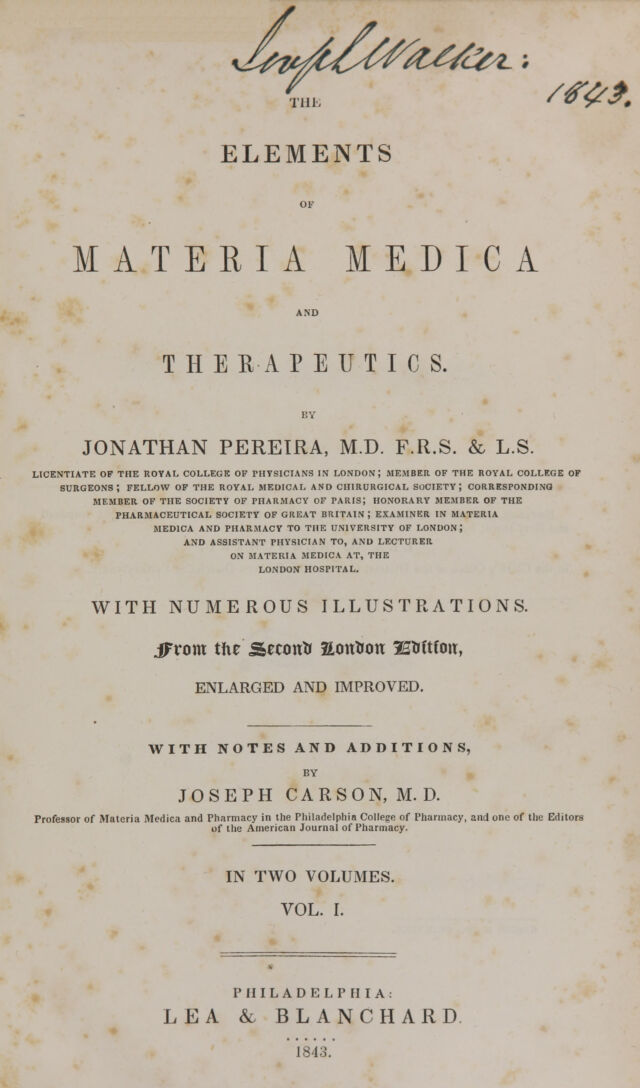
The elements of materia medica and therapeutics (Volume 1).
- Jonathan Pereira
- Date:
- 1843
Licence: Public Domain Mark
Credit: The elements of materia medica and therapeutics (Volume 1). Source: Wellcome Collection.
Provider: This material has been provided by the National Library of Medicine (U.S.), through the Medical Heritage Library. The original may be consulted at the National Library of Medicine (U.S.)
33/732
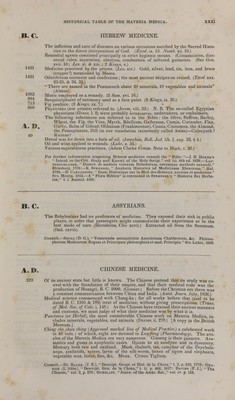
![B. C. HEBREW MEDICINE. The infliction and cure of diseases on various occasions ascribed by the Sacred Histo- rian to the direct interposition of God. (Exod. ix. 15. Numb. xii. 10.) Remedial agents consisted principally in strict hygienic means. (Circumcision, diet- etical rules, separation, ablution, combustion of infected garments. (See Gen. xvii. 10; Lev. xi. & xiii.; 2 Kings, v.) 1491 Medicine practised by the priests. (Lev. xiv.) Gold, silver, lead, tin, iron, and brass (copper ?) mentioned by Moses. 1491 Odoriferous ointment and confection; the most ancient recipes on record. (Exod.xxx. 23-25, & 34, 35.) There are named in the Pentateuch about 20 minerals, 10 vegetables and animals (Alston). 1063 Music employed as a remedy. (2 Sam. xvi. 16.) 884 Sesquisulphuret of antimony used as a face paint. (2 Kings, ix. 30.) /13 • Fig poultice. (2 Kings, xx. 7.) 600 Physicians (not priests) referred to. (Jerem. viii. 22.) N. B. The so-called Egyptian physicians (Genes. 1. 2) were probably Ivra^iaaTai, undertakers, or embalmers. The following substances are referred to in the Bible : the Olive, Saffron, Barley, Wheat, the Fig, the Vine, Myrrh, Bdellium, Galbanum, Cumin, Coriander, Flax, J\» D, Garlic, Balm of Gilead, Olibanum (Frankincense), Cassia, Cinnamon, the Almond, the Pomegranate, Dill (in our translation incorrectly called Anise)—Colocynth ? 40 Kicinus? Herod was let down into a bath of oil. (Josephus, Bell. Jud. lib. I. cap. 33, § 5.) Oil and wine applied to wounds. (Luke, x. 34.) Various superstitious practices. (Adam Clarke Comm. Note to Mark, v. 26.) For further information respecting Hebrew medicine consult the Bible;—J. H. Horne's Introd. to theCrit. Study and Kuowl. of the Holy Script. vol. iii. 8th ed. 1839;—Lau- tenschlager, Dissert, de inedicis veterum Hebrseorum, eorumque methodo sanandi, Strashurjr, 1786;—K. Sprengel, Analecta Historica ad Medicinam EbrEeorum, Hal. 1796.—D. Carcassone, Essai Historique sur la Med.des Hebreux, anciens et modernes. 8vo. Montp. 1815.—A Flora Biblica is contained in Sprengel's Historia Rei Herba- ria, t. i. Amstel. 1807. B. C. ASSYRIANS. The Babylonians had no professors of medicine. They exposed their sick in public places, in order that passengers might communicate their experience as to the best mode of cure (Herodotus, Clio xcvii.) Extracted oil from the Sesamum. (Ibid, cxviii). Consult,—Smoll (D. G.), Venerandte antiquitatis Assyriorum Chaldaeoruni, &c. Philoso- phorum Medicorum Regum et Principum philosopliicaet med. Principia.4to. Lubec, 1609. A.D. CHINESE MEDICINE. 229 Of its ancient state but little is known. The Chinese pretend that its study was co- eval with the foundation of their empire, and that their medical code was the production of Hoangti, B. C. 2000. (Grosier.) Before the Christian era there was a constant communication between China and India. (Asiat. Journ. July, 1836.) Medical science commenced with Chang-ka; for all works before that (said to be dated B. C. 1105 & 189) treat of medicine, without giving prescriptions. (Trans, of Med. Soc. of Calc. i. 146.) As the Chinese have retained their ancient manners and customs, we must judge of what their medicine was by what it is. Pun-tsaou (or Herbal), the most considerable Chinese work on Materia Medica, in- cludes minerals, vegetables, and animals. (Davies. ii. 278.) [A copy in the British Museum.] Chine che chioi ching (Apjnoved marked line of Medical Practice.) a celebrated work in 40 vols.; of which, eight are devoted to Luy-fang (Pharmacology). The arti- cles of the Materia Medica are very numerous. Ginseng is their panacea. Aro- matics and gums in apoplectic cases. Opium as an anodyne and in dysentery. Mercury both raw and oxidized. Musk, rhubarb, tea, camphor of the Dryobala- nops, asafictida, spices, larvae of the silk-worm, bones of tigers and elephants, vegetable wax, horns, fins, &c. Moxa. Croton Tiglium. Consult,—Du Halde, (J. B.), Descript. Geogr. et Hist, de la China, t. 3, p. 318, 1770; Gro- sier (L'Abbe), Descript. Gen. de la China, t. ii. p. 466, 1817: Davies (F. J.), The Chinese, vol. 2, p. 278; Gutzlaff\ Journ. of the Asiat. Soc, vol. iv. p. 154.](https://iiif.wellcomecollection.org/image/b21146810_0033.jp2/full/800%2C/0/default.jpg)