The elements of materia medica and therapeutics (Volume 1).
- Jonathan Pereira
- Date:
- 1843
Licence: Public Domain Mark
Credit: The elements of materia medica and therapeutics (Volume 1). Source: Wellcome Collection.
Provider: This material has been provided by the National Library of Medicine (U.S.), through the Medical Heritage Library. The original may be consulted at the National Library of Medicine (U.S.)
48/732
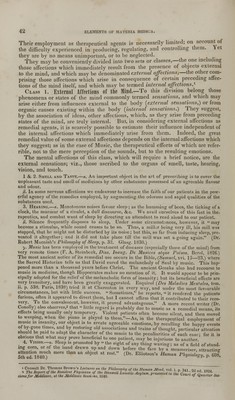
![Their employment as therapeutical agents is necessarily limited; on account of the difficulty experienced in producing, regulating, and controlling them. Yet they are by no means unimportant, or to be neglected. They may be conveniently divided into two sets or classes,—the one including those affections which immediately result from the presence of objects external to the mind, and which may be denominated external affections;—the other com- prising those affections which arise in consequence of certain preceding affec- tions of the mind itself, and which may be termed internal affections.1 Class l. External Affections of tlie Mind.—To this division belong those phenomena or states of the mind commonly termed sensations, and which may arise either from influences external to the body (external sensations,) or from organic causes existing within the body (internal sensations.) They suggest, by the association of ideas, other affections, which, as they arise from preceding states of the mind, are truly internal. But, in considering external affections as remedial agents, it is scarcely possible to estimate their influence independent of the internal affections which immediately arise from them. Indeed, the great remedial value of some external affections depends on the internal affections which they suggest; as in the case of Music, the therapeutical effects of which are refer- rible, not to the mere perception of the sounds, but to the resulting emotions. The mental affections of this class, which will require a brief notice, are the external sensations; viz., those ascribed to the organs of smell, taste, hearing, vision, and touch. 1 & 2. Smell and Taste.—at. An important object in the art of prescribing is to cover the unpleasant taste and smell of medicines by other substances possessed of an agreeable flavour and odour. /3. In some nervous affections we endeavour to increase the faith of our patients in the pow- erful agency of the remedies employed, by augmenting the odorous and sapid qualities of the substances used. 3. Hearing.—«. Monotonous noises favour sleep; as the humming of bees, the ticking of a clock, the murmur of a rivulet, a dull discourse, &c. We avail ourselves of this fact in the- rapeutics, and combat want of sleep by directing an attendant to read aloud to our patient. /S. Silence frequently disposes to sleep. Under some circumstances, however, it may become a stimulus, while sound ceases to be so. Thus, a millor being very ill, his mill was stopped, that he might not be disturbed by its noise; but this, so far from inducing sleep, pre- vented it altogether; and it did not take place till the mill was set agoing again. (Dr. Robert Macnish's Philosophy of Sleep, p. 32. Glasg. 1830.) y. Music has been employed in the treatment of diseases (especially those of the mind) from very remote times (F. A. Steinbeck, Diss. Inaug. De Musices alque Poesos, Bern], 1826.) The most ancient notice of its remedial use occurs in the Bible, (Samuel, xvi. 15—23,) where the Sacred Historian tells us that David cured the melancholy of Saul by music. This hap- pened more than a thousand years before Christ. The ancient Greeks also had recourse to music in medicine, though Hippocrates makes no mention of it. It would appear to be prin- cipally adapted for the relief of the melancholic form of insanity; hut its beneficial effects are very transitory, and have been greatly exaggerated. Esquirol (Des Maladies Mentales, torn, ii. p. 538. Paris, 1838) tried it at Charenton in every way, and under the most favourable circumstances, but with little success. Sometimes, he reports, it rendered the patients furious, often it appeared to divert them, but I cannot affirm that it contributed to their reco- very. To the convalescent, however, it proved advantageous. A more recent writer (Dr. Conolly) also observes,2 that little regard is probably due to music as a remedial means, its effects being usually only temporary. Violent patients often become silent, and then moved to weeping, when the piano is played to them.—As, in the therapeutical employment of music in insanity, our object is to create agreeable emotions, by recalling the happy events °i y:KUG t,me'S a?d bvLreSt,0ring: 0,d ass°ciations and trains of thought, particular attention should be paid to adapt the character of the music to the peculiarities of each case; for it is obvious that what may prove beneficial to one patient, may be injurious to another 4. Vision.—*. Sleep is promoted by the sight of any thing waving; as of a field of stand- ing corn, or of the hand drawn up and down before the face by a mesmeriser, attracting fthendO1840U) ^^ ^ JGCt ^ rCSl* (Dr> Elliotson's Human Physiology, p. 608, Consult Dr. Thomas Brown's Lectures on the Philosophy of the Human Mind, vol. i. n 341 2,1 PH iso* * The Report of the Resident Physician of the Hanioell Lunatic Asylum, presented to thcCourt «r - * tins for Middlesex,, at the Middlesex Stssi ms, ltiiO. »*»«« <o inc Lourt of Quarter Ses- sions for Middlesex, at the Middlesex Scssijns, ld-10](https://iiif.wellcomecollection.org/image/b21146810_0048.jp2/full/800%2C/0/default.jpg)