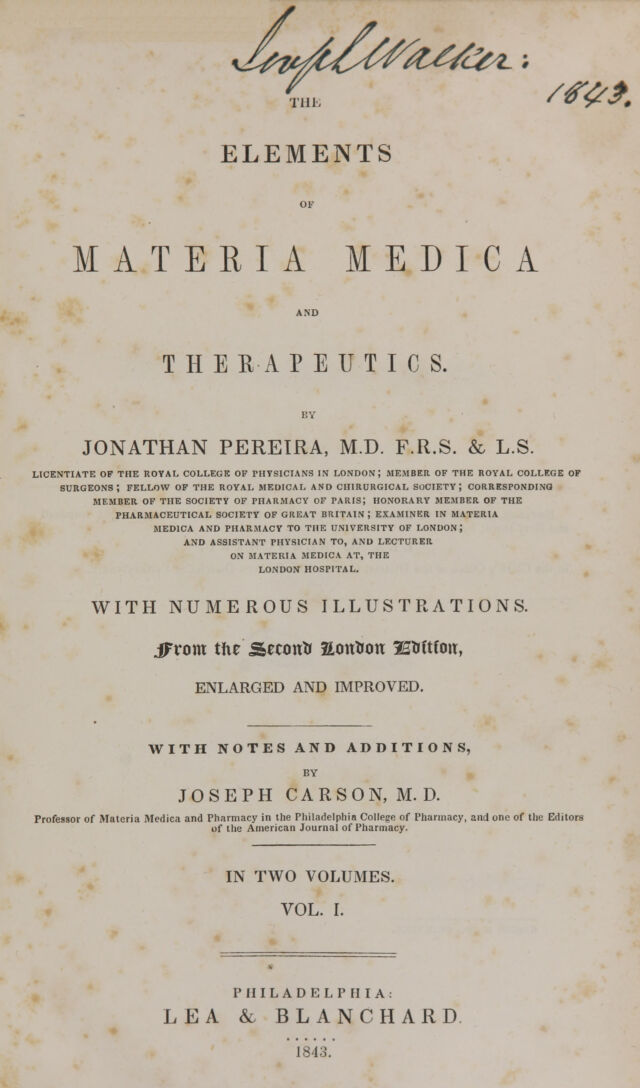
The elements of materia medica and therapeutics (Volume 1).
- Jonathan Pereira
- Date:
- 1843
Licence: Public Domain Mark
Credit: The elements of materia medica and therapeutics (Volume 1). Source: Wellcome Collection.
Provider: This material has been provided by the National Library of Medicine (U.S.), through the Medical Heritage Library. The original may be consulted at the National Library of Medicine (U.S.)
50/732
![means. The influence of the imagination on disease Iks long: been known, and isij frn.lful source of fallacy in therapeutics. Extraordinary cues have frequently ^. ^f^;^ and useless means, when in fact, they were referribto to the influence of the ■£»»™»V Fear is a depressing and debilitating passion, of whose power over disease the P*0 has sometimes availed himself Thus, Boerhaave prevented theJ-eeurrencof ^1*^™ (brought on by a person falling down in a lit in .he sight of the hospital P^f^S^SSS! a red hot iron to be applied to the person who should next be affected. (Falconer s Dissert. before quoted, p. 100.) 2. REMEDIA SOMATICA—SOMATICAL OR CORPORAL REMEDIES. Those remedies which act on the body directly, and which we have denomi- nated Somatical or Corporal, admit of arrangement into four classes, as follows: I. Physical but Imponderable Agents, as Light, Heat, Electricity, and Magnetism. II. Hygienic Agents, as Diet, Exercise, and Climate. III. Mechanical and Surgical Agents. IV. Pharmacological Agents or Medicines. I. AGENTIA PUYSICA.-PHYSICAL BUT IMPONDERABLE AGENTS. 1. Lux.—Light. (Lumen.) Physiological Effects.—Light acts as a vivifying or vital stimulus2 to living beings. It promotes the nutritive processes of vegetables, and its absence is the cause of that curious phenomenon denominated the sleep of plants. A morbid condition, called etiolation, or blanching, is induced in vegetables by growing them in obscure places.3 On animals, light operates in a two-fold manner: it promotes their development and nutrition, and it acts as a specific stimulus to the eye, as the organ of vision.4 Privation of light disposes to inactivity and sleep. The disease, called Antenna or Hypsemia in man, is analogous to the condition termed etiolation in vegetables; and, like the latter, is sometimes referrible to deprivation of light, combined, however, with other deleterious causes.5 Blind- ness (retinitis?) occasionally results from the exposure of the eye to strong light. The effect of the sun-stroke (coi/p de solcil or ictus Solaris,) in inducing inflam- mation of the brain, may be, in part, perhaps, owing to the influence of the light of the solar rays. Uses.—In maladies characterized by imperfect nutrition and Sanguification, as scrofula, rickets, and anaemia, and in weakly subjects with oedematous limbs, i See Dr. Haygarth's 0/ the Imagination, as a Cai.sc and a Cure nf Disorders of the Body; amplified hy fictitious Tractors and epidemical Convulsions; in the Loudon .Medical Review, vol. iii. p. '.>-', IrOO. Also Dr. Linii's Treatise on the .Scurry, p 343, et seq.; and p. 535. Med. 177'2 i The phrase vivifying or vital stimuli is used to designate those externa] conditions necessary to the main- tenance of life in organized beings; such as heat, air, water, and nutriment. They arc to be distinguished from the alterative or medicinal stimuli, which, while they cause temporary excitement, ultimately exhaust. (See Mullet s Elements of Physiology, bv Balv, vol. i. pp. 28 and 57 ) 3 For details respecting the influence of light on vegetation, consult J. C. Ebermaier, Vcrsuch einer Oeschichte des Ltehtes, Osnabruck, 1799; Landgrebe, Ueber das Licht oonugsioeise uber die chemiscken und 1009,' pfris 1K*2kun'en de88elben> P' 18<- Marburg, 1834.-Also, De Candolie, Physiologie iugeta/e, t. iii. p. On the influence of light on animals, see J. C. Ebermai ntsot mines, aungeons, and other subterraneous abodes; and for complete contrasts to Urn V, 1,ve lyto exam.ne the complexions of stagecoachmen, shepherds, and the sailor 'on the h , -1, i iv ist. (Dr. James Johnson, Change of Air, p. 7, 4th ed. lt>36 ) ° d sl(ly](https://iiif.wellcomecollection.org/image/b21146810_0050.jp2/full/800%2C/0/default.jpg)