The elements of materia medica and therapeutics (Volume 1).
- Jonathan Pereira
- Date:
- 1843
Licence: Public Domain Mark
Credit: The elements of materia medica and therapeutics (Volume 1). Source: Wellcome Collection.
Provider: This material has been provided by the National Library of Medicine (U.S.), through the Medical Heritage Library. The original may be consulted at the National Library of Medicine (U.S.)
58/732
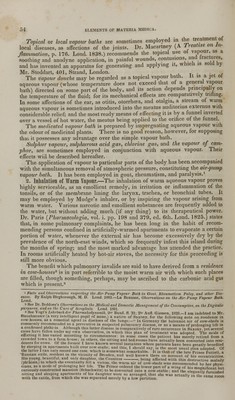
![On the right is the eleothe. Hum (AXtiTrrnfiov) where the oils and perfumes are kept in vases: next to this is the frigidarium (*a>'JuT»pM) or dressing-room: the third apartment is the tepi. darium : the fourth is the suda- tory (concamerata sudatio,) in Oi H Iff^f-f^ ■'ll'lj' BfjiSj\ JjB|l| |jj ] which arc seen the laconicum \\Wk\ lIlR''''ilk J ISI^W^ |W Ui^^|l||liffi (so called from being first used • fflMW llffl!ltf»IIaK$ ifl'n 11 VwBESa WM® Ba^^MfflLTmrill!!I 'n I':'coma>) u hrazen furnace to wi HrallpPlir$ WmnflsP^Pl Sllt^ililSiilS neat tlie room' ancl Persons sit- mm MV^^'-^_tM^E^itLlL-—^r^ 1 1 ting on the steps: the fifth is lBliMiilB[i|EEHro]raill(li^E ■:■ .ijMT the balneum, with its huge ba- I S14| If) I||| Wi HBBB^ sin {labium,) supplied by pipes, ||M||[ |W| 1 -^—' 1 1^1 \mmmi^^ communicating with three large Ancient Baths. bronze vases, called milliaria, a. The Strigil (a scraper or currycomb, used at baths to scrape from their capaciousness; the the skin.) lower one contained hot, the upper one cold, and the middle one tepid water. The bathers returned back to the frigida- rium, which sometimes contained a cold bath. The subterranean portion of the building, where the fires were placed for heating the baths, was called the hypocaustum. 1. The Vapour Bath.—As aqueous vapour, like air, is a worse conductor of caloric than liquid water, its influence, as a source of either heat or cold, is neither so powerfully nor so speedily felt as that of the latter. Hence, there- fore, the temperature of the vapour bath should always exceed that of the water bath. If, however, the whole body be immersed in vapour, which is conse- quently inhaled, the temperature must be a little less than if the trunk and limbs alone were subjected to the influence of vapour; because the inhalation of vapour stops the cooling process of evaporation from the lungs. The following is a comparative view of the heating powers of water and of vapour, distinguishing the latter according as it is or is not breathed. (Dr. Forbes, Cyclopaedia of Practical Medicine, art. Bathing, vol. i. p. 265.) Water. Vapour. 85°— 92° 92° _ 98° 98° — 10G° Not breathed. Breathed. 96° — 106° 106°— 120° 120° — 160° 90° — 100° 100° — 110° 110° — 130° The general effects of the vapour bath are those of a powerful stimulant and sudorific. It softens and relaxes the cutaneous tissue, expands the superficial vessels, accelerates the circulation of blood, augments the frequency of the pulse and respiration, and produces copious perspiration. These effects are succeeded by a feeling of languor and a tendency to sleep. The vapour bath is distinguished from the hot-air bath by its soothing, relax- ing, and greater sudorific influence; from the hot-water bath, by its inferior power of communicating heat, by its greater sudorific tendency, and by its causing scarcely any superficial compression of the body, whereby it does not occasion the praicordial oppression experienced on entering the water bath. The vapour bath, like the hot-air bath, may be employed when the blood has receded from superficial parts, and congestion of internal organs has in conse- quence occurred;—as during the cold stage of intermittent fever, in malignant cholera, and during the stage of chilliness which ushers in various febrile com- plaints. But its great value is experienced when our object is to relax the skin,](https://iiif.wellcomecollection.org/image/b21146810_0058.jp2/full/800%2C/0/default.jpg)