Volume 1
A treatise on the science and practice of midwifery / by W.S. Playfair.
- William Smoult Playfair
- Date:
- 1878
Licence: Public Domain Mark
Credit: A treatise on the science and practice of midwifery / by W.S. Playfair. Source: Wellcome Collection.
Provider: This material has been provided by The University of Leeds Library. The original may be consulted at The University of Leeds Library.
284/432 (page 260)
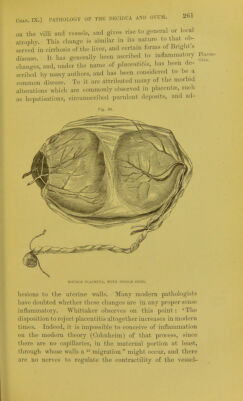
![200 PREGN.\;sX'Y. [Paht ]r. generation of the connective tissue of the chorion. This is, however, too little understood to require further observation. I'atlioU.fry The pathology of the placenta has of late years attracted pliu'ciita. i^^ch attention, and it has an important practical bearing, in consequence of its effects on the child. Placentae va,ry considerably in shape. They may be cre- scent ic, or spread over a considerable surface, in consequence of the chorion villi entering into communication with a larger portion of the decidua than usual (Placenta memhranacexi). Such forms, however, are merely of scientific interest. The only anomaly of shape of any practical importance is the formation of what have been called placenta} succenturioi. These consist of one or more separate masses of placental tissue, produced by the development of isolated patches of chorion villi. Hohl believes that they always form exactly at the junction of the anterior and posterior walls of the uterus, which in early pregnancy is a mere line. As the uterus expands, the portions of placenta on each side of this become separated from each other. They are only of consequence from the possibility of their remaining un- noticed in the uterus after delivery, and giving rise to secondary post-partum haemorrhage. The rare form of double placenta with a single cord, figured in the accom- panying woodcut (fig. 86), was probably formed in this way, and the supplementary portion, in such a case, might readily escape notice. The placenta may also vary in dimensions. Sometimes it is of excessive size, generally when the child is unusually big; but not unfrequently in connection with hydramnios, the child being dead and shrivelled. In other cases it is remarkably small, or at least appears to be so. If the child be healthy, this is probably of no pathological importance, as its smallness may be more apparent than real, depending on its vessels not being distended with blood. When true atrophy of the placenta exists, the vitality of the foetus may be seriously interfered with. This condition may depend either on a diseased state of the chorion villi, or of the decidua in which they are implanted.' The latter is the more common of the two ; and it generally consists in hyper- plasia of the connective tissue of the decidua, which presses](https://iiif.wellcomecollection.org/image/b21511810_0001_0284.jp2/full/800%2C/0/default.jpg)