The leverage of the lower human jaw : (an excerpt from the author's note-book) / by John Gorham.
- Gorham, John
- Date:
- 1875
Licence: Public Domain Mark
Credit: The leverage of the lower human jaw : (an excerpt from the author's note-book) / by John Gorham. Source: Wellcome Collection.
Provider: This material has been provided by The Royal College of Surgeons of England. The original may be consulted at The Royal College of Surgeons of England.
3/16
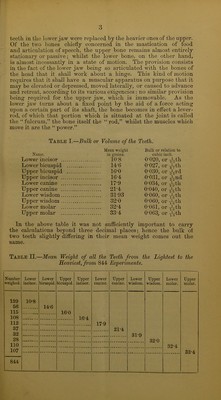
![0^) Reprinted from the ‘British Journal of Dental Science,’ February, 1875.] THE LEVERAGE OF THE LOWER HUMAN JAW. (An excerpt from the author’s note-book.) By John Gorham, M.R.C.S. Eng., &c. (Reprinted from the ‘ Medical Times and Gazette.’) Data.—Average Weight of each Single Tooth in Grains—Average Weight of all the Teeth in Gi'ains—Weight of lower Jaw in Grains, without the Teeth—Weight of Lower Jaw with its Full Complement of Teeth in Grains—Centre of Gravity of Lower Jaw—Position of Fulcrum—Long Arm in Inches—Short arm in Inches—Fulcrum of all the Teeth—Long Arm of each Tooth in Inches—Short Arm of each Tooth in Inches—Moment of each Tooth—Sum of Moments of all the Teeth. The Weight* and Bidk of the Teeth are always in the same ratio. Owing to the equal density of all the teeth, their weight and bulk coincide ; hence these terms are convertible, and are thus used in the following section. If the bulk of a lower incisor, for instance, which weighs ten grains, is equal to the one fiftieth of a cubic inch, then the weight of an upper canine, the bulk of which is equal to the one twenty-fifth of a cubic inch, will be twenty grains, and so on. In other words, if one tooth weigh twice as much as another, it will have twice the bulk. Relative Size of the Teeth. The largest teeth in the head are the upper molars (33'4 grs.), and the smallest are the lower incisors (10‘8 grs.): an upper molar is about three times as large, therefore, as a lower incisor. From the lower incisors the teeth increase in magnitude in the following order:—A lower bicuspid (14 grs.) is bigger by about four grains than a lower incisor, and an upper bicuspid (16 grs.) exceeds a lower in size by about two grains. Next in order come the upper incisors (16-4 grs.), which scarcely exceed in bulk the upper bicuspid. The lower canine stand next (17‘9 grs.), being a little larger than the upper incisors. Then follow the upper canine (21-4 grs.), which are much bigger than the lower, and about twice the size of the lower incisors. In the remaining groups the teeth are much larger: an upper wisdom (32 grs) is about thrice the size of a lower incisor ; the lower wisdom (319 grs.) is nearly the same in bulk. Finally, the largest teeth in the head are the molars. Relative Size of the Teeth in the Upper and Lower Jaiv. The teeth in the upper jaw are larger than those in the lower. The weight of all the teeth in the upper jaw is 370 grs., that of those in the lower 330 grs.,—showing a difference of 40 grs. The Difference between the Size of the Teeth in the Upper and Lower Jaw diminishes as they recede from the Front of the Mouth. The mean difference of an upper as compared with a lower in- cisor is 5'6 grs.; ol an upper canine to a lower, 3‘5 grs.; of an upper * For the loan of some thousands of teeth, in order to conduct these experi- ments, the author is indebted to Charles James Fox, Esq., Dental Surgeon to the Dental Hospital, London, and to John Franks, Esq., Surgeon, Sevenoaks, Kent.](https://iiif.wellcomecollection.org/image/b2243558x_0003.jp2/full/800%2C/0/default.jpg)