The Fauna of British India, including Ceylon and Burma / edited by A.E. Shipley. Freshwater sponges, Hydroids & Polyzoa / by N. Annandale.
- Date:
- 1911
Licence: In copyright
Credit: The Fauna of British India, including Ceylon and Burma / edited by A.E. Shipley. Freshwater sponges, Hydroids & Polyzoa / by N. Annandale. Source: Wellcome Collection.
Provider: This material has been provided by London School of Hygiene & Tropical Medicine Library & Archives Service. The original may be consulted at London School of Hygiene & Tropical Medicine Library & Archives Service.
96/288 (page 84)
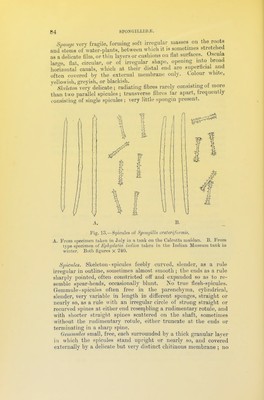
![Sponge very fragile, forming soft irregular masses on the roots and stems of water-plants, between which it is sometimes stretched as a delicate film, or thin layers or cushions on Hat surfaces. Oscula large, fiat, circular, or of irregular shape, opening into broaci horizontal canals, which at their distal end are superficial and often covered by the external membrane only. Colour white, yellowish, greyish, or blackish. . . Skeleton very delicate; radiating fibres rarely consisting ot more than two parallel spicules; transverse fibres far apart, frequently consisting of single spicules; very little spongin present. Fig. 13.—Spicules of Spongilla cratcriformis. A. From specimen taken in July in a tank on the Calcutta maiclau. B. From type specimen of Ephi/datia indica taken in the Indian Museum tank in winter. Both figures X 240. Spicules. Skeleton-spicules feebly curved, slender, as a rule irregular in outline, sometimes almost smooth ; the ends as a rule sharply pointed, often constricted off and expanded so as to re- semble spear-heads, occasionally blunt. ]STo true flesh-spicules. Gemmule-spicules often free in the parenchyma, cylindrical, slender, very variable in length in different sponges, straight or nearly so, as a rule with an irregular circle of strong straight or recurved spines at either end resembling a rudimentary rotule, and with shorter straight spines scattered on the shaft, sometimes without the rudimentary rotule, either truncate at the ends or terminating in a sharp spine. Gemmules small, free, each surrounded by a thick granular layer in which the spicules stand upright or nearly so, and covered externally by a delicate but very distinct chitinous membrane ; no](https://iiif.wellcomecollection.org/image/b21352756_0096.jp2/full/800%2C/0/default.jpg)