A Text-book of medical practice for practitioners and students / edited by William Bain.
- Date:
- 1904
Licence: In copyright
Credit: A Text-book of medical practice for practitioners and students / edited by William Bain. Source: Wellcome Collection.
Provider: This material has been provided by The University of Leeds Library. The original may be consulted at The University of Leeds Library.
33/1042 page 5
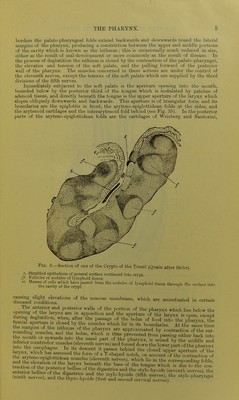
![bordex's the palato-pharyiigeal folds extend backwards and downwards round the lateral •margins of the pharynx, j^roducing a constriction between the upper and middle portions of the cavity which is known as tlie isthnuis ; this is occasionally much reduced in size, either as the result of mal-developnient or more counaonly as the result of disease. In the process of deglutition the isthmus is closed by the contracticm of the palato-pharyngei, the elevatioi and tension of the soft palate, and the pulling forward of the posterior wall of the pharynx. The muscles concerned in these actions are under the control of the eleventh nerves, except the tensors of the soft palate which are supplied by the third divisions of the fifth nerves. Immediately subjacent to the soft palate is the aperture opening into the mouth, bounded below by the posterior thii-d of the tongue which is nodulated by patches of adenoid tissue, and directly beneath the tongue is the upper aperture of the larynx which slopes obliquely downwards and backwards. This aperture is of triangular form and its boundaries are the epiglottis in front, the aryteno-epiglottidean folds at the sides, and the arytenoid cartilages and the interarytenoid fold behind (see Fig. 35). In the posterior parts of the aryteno-epiglottidean folds are the cartilages of Wrisberg and Santorini, Fig. 3.—Section of one of the Crypts of the Tonsil (Quain after Sfcohr). e. Stratified epithelium of general surface continued into crypt //. Follicles or nodules of lymphoid tissue. ss. h^Passed from the nodules of lymphoid tissue through the surface into SlsfdSd^itionr*'^^ ^^'^ membrane, which are accentuated in certain onen^!;. fT^^l.?*^ posterior walls of the portion of the pharynx which lies below the openmg of the larynx are in apposition and the aperture of the larynx is open except during deglutition, when after the passage of the bolus of food intfth^ pWnx the ^re mLSns oT'tie tV^ «ie -.scles which lie in its boundaries. At the same time rnnJ^^ ^ 1 ^sthmus of the pharynx are approximated by contraction of the sur- rounding muscles, and the bolus, which is thns prevented froni%ssing eithei^Lck nto the mouth or upwards into the nasal part of the pharynx, is seized bf the middle and inferior constrictor muscles (eleventh nerves) and forced dowA the lower part of larynx nto the (esophagus. In its descent it passes behind the closed upper apLture of the tKklmTenlTc hT'^ ff ^ Tr^'^^'^ account\!f th^S^ition o? ami tZ e]lvZtff ^^'''\ '''^t' ^^Tl? T'^'^' ^^^^'^ ^he corresponding folds, faction of S^n^^^^^^^^^ ^fT'^r ^^'f ^'^ ^^'^ ^^''^h is due to the con^ Ster rbellts^J S of the digastrics and the stylo-liyoids (seventh nerves), the r^i^tTnervesT 15^^^^^ and mylo-hyoids (fifth nerves), the stvlo-pharyngei (.ninth neives), and the thyro-hyoids (first and second cervical nerves).](https://iiif.wellcomecollection.org/image/b21510167_0033.jp2/full/800%2C/0/default.jpg)